


Dr. Alan Parks, MD, is the founder of Americans for a Balanced Budget Amendment. He sent me an e-mail notifying me of his new website. I perused for a bit, and found it worth mentioning. He's already gathered an endorsement from noted personal finance guru Dave Ramsey.
Dr. Parks ran across this post of mine in support of a balanced budget amendment. I tend to channel William Buckley when I'm emotional, as my vocabulary soars above my standard typo ridden fare. Looking back at it, I'm still pleased with it.
At any rate, check out Americans for a Balanced Budget Amendment, and lend your support.
Showing posts with label Reforms. Show all posts
Showing posts with label Reforms. Show all posts
Monday, April 20, 2009


Sunday, March 15, 2009
Let's Privatize our Universities
A few years ago the Texas legislature decided to allow state Universities to set their own tuition rates. The idea was to introduce market based tuition rates to induce students to make better choices on the college they attend and the major they pursue. Previously, tuition applied to all majors equally and tuition increases had to be approved by the legislature.
However, tuition rates have been rising at a rate unpopular with many citizens. Some groups are now demanding a tuition rate cut.
This puts state universities in a tough position. The state has not increased funding commensurate with costs, and without the ability to raise revenue through tuition costs, they feel that they are not going to maintain the quality education desired. Texas A&M University, in its Vision 2020 plan, explicitly states their desire to raise revenue to enhance the stature of the university along with lip service towards better use of existing resources.
The question most legislators are looking at is whether we should allow state universities to gather more revenue, or should we try to offer a more affordable college education. The question I want to ask is – Should the state be in the university business to begin with?
The fundamental problem that prevents universities from providing a high quality education at a low cost, is the lack of the profit incentive. From top to bottom, state university officials lack the incentives to pursue an efficient allocation of resources. Their incentives are more likely aligned with expanding their budget and increasing the prestige of their individual departments.
There is also an inherent unfairness in government funding of universities in Texas. Generally speaking, Texas heavily subsidizes students who are going to be wealthy and come from homes with above average incomes. Taxes from low-income individuals are going to subsidize the education and income potential of other people’s children. The best and brightest, which are already likely to make substantial incomes, are more likely to graduate, and pursue degrees with the most associated costs as well, such as engineering.
Since our society is probably not ready to do away with all school subsidies, I'm willing to propose that Texas switch to a system of scholarships for high performing and disadvantaged students. Each university would be required through competition to attract the students and their scholarship money to their respective schools.
Going further, to assure that the universities will be forced to economize their resources, I suggest that we begin to privatize public universities across the state. Furthermore, I nominate my own alma mater, Texas A&M, to be the first. It's time to get the state out of education.
However, tuition rates have been rising at a rate unpopular with many citizens. Some groups are now demanding a tuition rate cut.
This puts state universities in a tough position. The state has not increased funding commensurate with costs, and without the ability to raise revenue through tuition costs, they feel that they are not going to maintain the quality education desired. Texas A&M University, in its Vision 2020 plan, explicitly states their desire to raise revenue to enhance the stature of the university along with lip service towards better use of existing resources.
The question most legislators are looking at is whether we should allow state universities to gather more revenue, or should we try to offer a more affordable college education. The question I want to ask is – Should the state be in the university business to begin with?
The fundamental problem that prevents universities from providing a high quality education at a low cost, is the lack of the profit incentive. From top to bottom, state university officials lack the incentives to pursue an efficient allocation of resources. Their incentives are more likely aligned with expanding their budget and increasing the prestige of their individual departments.
There is also an inherent unfairness in government funding of universities in Texas. Generally speaking, Texas heavily subsidizes students who are going to be wealthy and come from homes with above average incomes. Taxes from low-income individuals are going to subsidize the education and income potential of other people’s children. The best and brightest, which are already likely to make substantial incomes, are more likely to graduate, and pursue degrees with the most associated costs as well, such as engineering.
Since our society is probably not ready to do away with all school subsidies, I'm willing to propose that Texas switch to a system of scholarships for high performing and disadvantaged students. Each university would be required through competition to attract the students and their scholarship money to their respective schools.
Going further, to assure that the universities will be forced to economize their resources, I suggest that we begin to privatize public universities across the state. Furthermore, I nominate my own alma mater, Texas A&M, to be the first. It's time to get the state out of education.
Tuesday, March 10, 2009
More on Mark-to-Market
First, a couple links.
My friend John Tamny has an article today at RealClearMarkets in defense of mark-to-market. He seems to be saying that it isn't mark-to-market that failed, but government intervention in the mortgage market that has made those assets impossible to price.
Bob Murphy linked to this blogpost that seems to agree with my position, but gets deeper into the details. Bob calls it the "definitive" post on the issue. He exaggerates, but it's still worth reading.
Second, is the fact that suspending or rescending MTM has virtually no chance of happening. Barack Obama and the Democrats could not support a bill that went against their narrative of "Government Good/Wall Street Bad". Suspending MTM would be an admission that government oversight had failed and that regulation itself was a major culprit in the banking crisis.
My friend John Tamny has an article today at RealClearMarkets in defense of mark-to-market. He seems to be saying that it isn't mark-to-market that failed, but government intervention in the mortgage market that has made those assets impossible to price.
Bob Murphy linked to this blogpost that seems to agree with my position, but gets deeper into the details. Bob calls it the "definitive" post on the issue. He exaggerates, but it's still worth reading.
Second, is the fact that suspending or rescending MTM has virtually no chance of happening. Barack Obama and the Democrats could not support a bill that went against their narrative of "Government Good/Wall Street Bad". Suspending MTM would be an admission that government oversight had failed and that regulation itself was a major culprit in the banking crisis.
Sunday, March 8, 2009
Yes to Suspending Mark-to-Market
Steve Forbes has been beating a drum over the last month, repeating his call to suspend mark-to-market accounting rules. I think that I have finally been fully convinced that this is a good idea. Not permanent suspension, but perhaps a two year holiday from these requirements.
As an employee of one of these bailout blackholes, I have seen the damage to my firm from these kinds of rules. If it were not for them, I suspect that we would never have needed a single dime of government money. Companies with positive cashflow should not be going insolvent because the market value of assets that have not defaulted and they do not intend to sell have lost value.
Why is mark-to-market good?
It forces companies to report what the actual value of their securities are, and not just what they paid for them (like under book value accounting). As an analogy: Say Bob is applying for a new $2 million construction loan to build an apartment complex. He is using his existing complex, which he bought 3 years ago for $2 million as collateral. The problem is, that his old complex has been condemned by the city for health code violations. His collateral would only sell for $1 million on the open market as of today.
Corporations sometimes do the same thing. They buy assets at price X, those assets plummet to price Y, yet they report the value and solvency of the company based on a depreciation model or book value based on price X.
Why is mark-to-market bad?
When fears of corporate defaults are more random, it is fine. If it is feared that Company A will default, then companies B – Z write down any assets they held in company A. Fortunately, those losses are spread across a large number of companies. There is damage, but it isn’t that bad. Mind you, this can occur under the fear of defaults, and not actual default.
When fears of corporate defaults are widespread, it can cause a cascading effect of failures. If it is feared that companies A-I default, then J-Z have to write down those assets. Because of the large write downs by companies J-Z, fears of wider defaults grow. A vicious cycle develops, what we’ve dubbed “contagion”. A critical mass of write downs can lead to total meltdown like we’ve seen.
Using another analogy:
Imagine that you bought a house for $500,000. You had $100,000 down, so you borrowed $400,000. Imagine too that everyone in your city has done the same thing. Due to current market conditions the value of your homes fall by $200,000. Everyone in town now owes around $400,000, but has homes that are only worth $300,000.
As it is right now, the vast majority will just ride it out. They will keep paying their mortgages and prices will eventually rise over the coming years and you will all be back in the black some day. My parents did this during the Oil Bust here in Houston during the 80s.
Now, let’s assume that all home loans required mark-to-market accounting. That is, if your home lost value, you were required to post more collateral to cover the loans. Everyone in town now had to come up with $100,000 of assets to add as collateral. Anyone who failed to do so within 3 months would have their homes repossessed.
What do you think would happen to this town? As repossessions soared, prices would fall further, requiring even more assets to be posted. The town would be destroyed. Virtually no one would be able to keep their home.
In short, I think Mark-to-Market is good 95% of the time, but it creates a systemic risk during a financial slowdown. I agree with Steve Forbes, and I think there should be a 2-year suspension for most firms.
As an employee of one of these bailout blackholes, I have seen the damage to my firm from these kinds of rules. If it were not for them, I suspect that we would never have needed a single dime of government money. Companies with positive cashflow should not be going insolvent because the market value of assets that have not defaulted and they do not intend to sell have lost value.
Why is mark-to-market good?
It forces companies to report what the actual value of their securities are, and not just what they paid for them (like under book value accounting). As an analogy: Say Bob is applying for a new $2 million construction loan to build an apartment complex. He is using his existing complex, which he bought 3 years ago for $2 million as collateral. The problem is, that his old complex has been condemned by the city for health code violations. His collateral would only sell for $1 million on the open market as of today.
Corporations sometimes do the same thing. They buy assets at price X, those assets plummet to price Y, yet they report the value and solvency of the company based on a depreciation model or book value based on price X.
Why is mark-to-market bad?
When fears of corporate defaults are more random, it is fine. If it is feared that Company A will default, then companies B – Z write down any assets they held in company A. Fortunately, those losses are spread across a large number of companies. There is damage, but it isn’t that bad. Mind you, this can occur under the fear of defaults, and not actual default.
When fears of corporate defaults are widespread, it can cause a cascading effect of failures. If it is feared that companies A-I default, then J-Z have to write down those assets. Because of the large write downs by companies J-Z, fears of wider defaults grow. A vicious cycle develops, what we’ve dubbed “contagion”. A critical mass of write downs can lead to total meltdown like we’ve seen.
Using another analogy:
Imagine that you bought a house for $500,000. You had $100,000 down, so you borrowed $400,000. Imagine too that everyone in your city has done the same thing. Due to current market conditions the value of your homes fall by $200,000. Everyone in town now owes around $400,000, but has homes that are only worth $300,000.
As it is right now, the vast majority will just ride it out. They will keep paying their mortgages and prices will eventually rise over the coming years and you will all be back in the black some day. My parents did this during the Oil Bust here in Houston during the 80s.
Now, let’s assume that all home loans required mark-to-market accounting. That is, if your home lost value, you were required to post more collateral to cover the loans. Everyone in town now had to come up with $100,000 of assets to add as collateral. Anyone who failed to do so within 3 months would have their homes repossessed.
What do you think would happen to this town? As repossessions soared, prices would fall further, requiring even more assets to be posted. The town would be destroyed. Virtually no one would be able to keep their home.
In short, I think Mark-to-Market is good 95% of the time, but it creates a systemic risk during a financial slowdown. I agree with Steve Forbes, and I think there should be a 2-year suspension for most firms.
Wednesday, December 31, 2008
A Gas Tax Salve for Housing Prices
I have previously written my skepticisms on raising the gas tax. Economist Greg Mankiw views it as a Pigovian Tax to help reach environmental social goals. I think that the environmental advantages are overblown as we saw only minor reductions in gasoline consumption when prices went up to $4.00.
However, given my skepticism, there is another social goal that can be achieved without violating my libertarian principals. If states were to increase gas taxes and in exchange lower property taxes this should help increase demand for homes.
However, given my skepticism, there is another social goal that can be achieved without violating my libertarian principals. If states were to increase gas taxes and in exchange lower property taxes this should help increase demand for homes.
I'm not sure what the total property tax revenue for California is, and their rate averages a pretty low 4.77/$1000 of valuation, but if you estimate that the average home is worth $400,000 in the state, then eliminating property taxes would save the average home owner a little over $1,900/year, or $158/month. Assuming 3.5 people per house, this means about 10 million homes, and thus $19 Billion in lost revenue.
On the gas tax revenue side we can again use some approximations. Americans use 390 million gallons of gasoline per day. If we assume California uses 1/8th, since they have about 1/8th of the population this equals 48.75 million gallons per day. Multiply by 365 days and you get around 17.8 billion gallons per year. If California were to charge a new tax of a dollar per gallon this would lead to around $17 Billion in revenue (assuming a slight decrease in driving).
This back of the envelope estimation might not be perfectly accurate, but it looks like the gasoline tax could help eliminate property taxes in the state. Getting rid of property taxes would make homes cheaper, but not lower their face value (sales price). It should help offset some downward pressure on home prices without the moral hazard problems of bailing them out. It also seems politically feasible given the "green" inclinations of the party in power.
Wednesday, December 17, 2008
Bailout Backlash
We're mad as hell, and we're not going to take it any more!
This weekend I watched Mitt Romney on one of the Sunday political shows. He gives lips service to free markets and then turns around and spends half his time talking about how we need a stimulus. Not the $1T spending style, but one mixed with spending and tax cuts. We've seen a number of moderate Republicans duck their heads and acquiesce to massive government intervention. Why? Because they are afraid. They haven't taken the time to properly educate themselves on economics, so they just want to look busy until it blows over.
If Republicans want to revive their influence, they have to take a stand. They have to start not just talking, but shouting, that we must end these bailouts and so-called stimulus packages. The average American does not like this at all. They are getting angry, and if the economy doesn't recover soon there is going to be hell to pay for the party left holding the bag. If Republicans speak up loudly now, they won't be holding that bag.
Brent Budowsky, from The Hill, has a column today with a lot populist overtones that echoes some of the sentiment that I see growing.
This weekend I watched Mitt Romney on one of the Sunday political shows. He gives lips service to free markets and then turns around and spends half his time talking about how we need a stimulus. Not the $1T spending style, but one mixed with spending and tax cuts. We've seen a number of moderate Republicans duck their heads and acquiesce to massive government intervention. Why? Because they are afraid. They haven't taken the time to properly educate themselves on economics, so they just want to look busy until it blows over.
If Republicans want to revive their influence, they have to take a stand. They have to start not just talking, but shouting, that we must end these bailouts and so-called stimulus packages. The average American does not like this at all. They are getting angry, and if the economy doesn't recover soon there is going to be hell to pay for the party left holding the bag. If Republicans speak up loudly now, they won't be holding that bag.
Brent Budowsky, from The Hill, has a column today with a lot populist overtones that echoes some of the sentiment that I see growing.
Americans have begun an angry backlash against bailouts that could become a national revolt in 2009.
...
Virtually none of this money directly helps average Americans. Virtually none of it trickles down to the people who suffer the most and pay for the program.
...
The public backlash is only beginning. It will rise with every new scandal and Ponzi scheme and every new increase in credit card rates. It has already infected good judgment in the auto case, where major support is needed, tied to major plans for industry renewal.
I do not oppose bailouts, I oppose bailouts managed with banana-republic standards of secrecy and incompetence in which recipients of massive taxpayer largesse work against those who pay for this largesse.
...
Bailout money is not a private account that belongs to Fed Chairman Ben Bernanke, Fed governors, the Treasury secretary or the banks. It is the people’s money. It should be used to benefit the people. It should be monitored through the checks and balances of the democratic process.
Secrecy is the enemy of equity, integrity and common sense. Secrecy is the friend of negligence, misjudgment and corruption. There are probably selected instances where the Fed should not disclose, but show me $2 trillion of secretly spent money and I will show you trouble.
In the coming days I will be writing about the Bloomberg case and offering specific bailout proposals on The Hill’s Pundits Blog. The backlash is coming. Time is short. The dangers are extreme.
Wednesday, December 10, 2008
I Have a Man-Crush
According to this story with The State, a South Carolina newspaper, (HT: Club for Growth), the governor of that state, Mark Sanford, wants to do the following:
1. Eliminate state Corporate Income Tax
2. Pay for it by eliminating Corporate Welfare tax breaks for politically desireable industries.
3. Switch the codified state income tax for a Flat Tax
Isn't he just dreamy. Maybe my wife would let me put his poster on the closet door.

Thursday, November 13, 2008
California Foreclosures Beginning to Fall
RealtyTrac released their new data for October today. Total foreclosures were 56,954 which is 13% higher than last year. But, this is an 18% drop from last month, and a whopping 44% drop from the all time high in August.
Below is a graph. Sorry for the gap for April and May of this year, but I can't find the data on the RealtyTrac website.

An important question needs to be asked. If foreclosures are beginning to trend downward, does the government need to institute policies to slow them? For any policy to be implemented it will likely take months to even get started. I beleive that the market will beat the government to the punch and fix the situation first.
Wednesday, October 29, 2008
A Partial Victory for Mexico
The Houston Chronicle reports that Felipe Calderon's legislative attempt to allow foreign investment into Pemex operations has passed. I have tried to push a bilateral agreement between the U.S. and Mexico to liberalize their Oil industry in exchange for more open worker programs and citizenship agreements.
The pertinent excerpts.
"The measures also will create a plan for performance bonuses for drilling and production contractors and will permit Pemex to sell bonds to the public, according to George Baker, a Houston analyst who specializes on Mexico's energy industry."
"While infuriating many on the left, the package fell short of what free-market proponents and private companies had hoped."
"Mexico's oil industry, which funds nearly 40 percent of the government's budget, has seen its production plummet in recent years as the huge Cantarell field, in the southern Gulf of Mexico, has begun to play out."
"Baker said the reforms may be a step in the right direction, but he added that that they do little to improve the chances of attracting foreign companies to drill in Mexico's deep-water Gulf. And, he said, time is running out."
"They have declining production, declining prices," Baker said. "There's even a greater urgency now than there was before."
The pertinent excerpts.
"The measures also will create a plan for performance bonuses for drilling and production contractors and will permit Pemex to sell bonds to the public, according to George Baker, a Houston analyst who specializes on Mexico's energy industry."
"While infuriating many on the left, the package fell short of what free-market proponents and private companies had hoped."
"Mexico's oil industry, which funds nearly 40 percent of the government's budget, has seen its production plummet in recent years as the huge Cantarell field, in the southern Gulf of Mexico, has begun to play out."
"Baker said the reforms may be a step in the right direction, but he added that that they do little to improve the chances of attracting foreign companies to drill in Mexico's deep-water Gulf. And, he said, time is running out."
"They have declining production, declining prices," Baker said. "There's even a greater urgency now than there was before."
Friday, September 19, 2008
Houston Needs Price Gouging
In the wee hours of Saturday, September 13th, Hurricane Ike came ashore in Galveston County, Texas, where I live. With my family safely housed with relatives on the far northwest side of Houston, I traveled Saturday afternoon to view the damage to my home situated several miles from the coast. I faced little traffic on the highways, few downed power lines, and had little problem getting to where I was going. Now, six days later delivery trucks don’t seem to be able to make it here. Houston’s mayor is still pleading companies to make deliveries of gas, food, and ice, as we sit in long lines for necessities and common comforts. How do we fix this problem? Legalize price gouging.
What was noticeable for a number of days after the storm was gasoline hoarding. Queues for gasoline extended multiple blocks and required several hours of patience. The overwhelming majority of customers not only completely filled the tanks within their vehicles, but they also filled one or more gasoline canisters. No one wanted to wait through another line, so the incentive from price controls was to purchase as much as possible to avoid the need to come back. Because of this incentive, the few gas stations that were open inevitably ran out of fuel, feeding a vicious cycle of panic and hoarding.
If gasoline prices had been allowed to float up to, say, $8, some people, including tightwads like me, would have chosen not to buy as much gasoline in hopes that the price would come down over the next few days. If the average customer was buying only 10 gallons of gasoline instead of 25, the stations would have been able to service more people because the incentives would be to self-ration and not as much to hoard.
The unseen benefits that $8 gasoline would have brought are alternative purchasing options. With enormous profit margins to be made, tanker trucks from the four corners of America would have set off to sell gasoline on the roadside, in parking lots, or door to door, quickly ending the shortage. Instead of getting on the phone and begging for supplies, the mayor could have concentrated on traditional city functions like restoring water, clearing roads and removing debris.
Now, the greatest shortage is electricity. While few incentives could encourage the power companies to work faster, nor for safety reasons should they, there are alternatives that price gouging could provide. The tens of thousands of people who own generators, but have now had their electricity restored, have likely tucked them back into the corner of the garage. If the price was allowed to double or triple, they would be placed in a much more helpful position of being able to pocket some cash now and buy another generator when the prices return to normal in the coming months. As it is, few individuals have an economic incentive to part with their generators and give them over to the hundreds of thousands facing weeks without electricity. Because price gouging is illegal, thousands of people are burning up precious gasoline hoping to hit the Home Depot lottery by being there when the next shipment of five generators arrives tomorrow.
The emotional pull for an egalitarian distribution of food seems to be even stronger than that for gasoline, but the same problems persisted in local supermarkets after the storm. As I picked up a few items at a recently opened store near my home, I witnessed food hoarding going on as well. A woman added nearly a dozen packages of hot dogs to her cart already half-full with bags of frozen chicken breasts, and other packaged meats. She then turned to advise the other two women she was with to grab some. Each added half a dozen packages to their carts. I don’t know their situation back home, but since the shelves were mostly bare already, it probably meant that other people arriving later would have to go without. If the store had hiked the prices of certain items even a few dollars, food types in short supply could have been enjoyed by more people not just the lucky few who discovered that the store had recently restocked.
It is hard to label a system that bans price gouging egalitarian when the winners are those who get lucky or simply have a high tolerance for waiting in line. We need to legalize price gouging. As I wait for my roof to be fixed and tree limbs to be hauled off, I am eating no hot dogs. Can someone tell FEMA to send more hot dogs?
What was noticeable for a number of days after the storm was gasoline hoarding. Queues for gasoline extended multiple blocks and required several hours of patience. The overwhelming majority of customers not only completely filled the tanks within their vehicles, but they also filled one or more gasoline canisters. No one wanted to wait through another line, so the incentive from price controls was to purchase as much as possible to avoid the need to come back. Because of this incentive, the few gas stations that were open inevitably ran out of fuel, feeding a vicious cycle of panic and hoarding.
If gasoline prices had been allowed to float up to, say, $8, some people, including tightwads like me, would have chosen not to buy as much gasoline in hopes that the price would come down over the next few days. If the average customer was buying only 10 gallons of gasoline instead of 25, the stations would have been able to service more people because the incentives would be to self-ration and not as much to hoard.
The unseen benefits that $8 gasoline would have brought are alternative purchasing options. With enormous profit margins to be made, tanker trucks from the four corners of America would have set off to sell gasoline on the roadside, in parking lots, or door to door, quickly ending the shortage. Instead of getting on the phone and begging for supplies, the mayor could have concentrated on traditional city functions like restoring water, clearing roads and removing debris.
Now, the greatest shortage is electricity. While few incentives could encourage the power companies to work faster, nor for safety reasons should they, there are alternatives that price gouging could provide. The tens of thousands of people who own generators, but have now had their electricity restored, have likely tucked them back into the corner of the garage. If the price was allowed to double or triple, they would be placed in a much more helpful position of being able to pocket some cash now and buy another generator when the prices return to normal in the coming months. As it is, few individuals have an economic incentive to part with their generators and give them over to the hundreds of thousands facing weeks without electricity. Because price gouging is illegal, thousands of people are burning up precious gasoline hoping to hit the Home Depot lottery by being there when the next shipment of five generators arrives tomorrow.
The emotional pull for an egalitarian distribution of food seems to be even stronger than that for gasoline, but the same problems persisted in local supermarkets after the storm. As I picked up a few items at a recently opened store near my home, I witnessed food hoarding going on as well. A woman added nearly a dozen packages of hot dogs to her cart already half-full with bags of frozen chicken breasts, and other packaged meats. She then turned to advise the other two women she was with to grab some. Each added half a dozen packages to their carts. I don’t know their situation back home, but since the shelves were mostly bare already, it probably meant that other people arriving later would have to go without. If the store had hiked the prices of certain items even a few dollars, food types in short supply could have been enjoyed by more people not just the lucky few who discovered that the store had recently restocked.
It is hard to label a system that bans price gouging egalitarian when the winners are those who get lucky or simply have a high tolerance for waiting in line. We need to legalize price gouging. As I wait for my roof to be fixed and tree limbs to be hauled off, I am eating no hot dogs. Can someone tell FEMA to send more hot dogs?
Tuesday, September 2, 2008
Time to Eliminate the Federal Gas Tax
The Federal Gas Tax must go. It is part of the rent-seeking bog that has mired our Congress in excessive spending, and provides the murkiest pool of funds for pork barrel projects. It serves virtually no national interest and it wastes the time of lawmakers and federal officials.
I am not proposing a tax cut. I would fully expect most every state to increase their gas taxes to make up for the lost funds from federal transportation outlays. The point is for individual states to make decisions on transportation spending, and remove the bulk of funds that Congress hands out with a wink and a nod to friends, donors, and the well connected.
Many have attacked earmarks with good cause, but there are still those that defend them. The defenses go something like this:
“I was sent to Congress to fight for my state/district and make sure we get our fair share of federal funds”
or
“The citizens in my state/district would rather have their elected officials work for them instead of relying on some bureaucrat”
Should individual states get their fair share of gas tax revenue? Yes, by never sending the money to Washington in the first place.
Who should decide how gas tax revenue in Delaware be spent? The people of Delaware. If Oklahoma wants to build freeways, then let them use their own money. If Oregon wants no freeways and only light rail, then let them use their own money. Funding should not be based on the seniority of a state’s congressional delegation. It should be decided with the reasonable judgment of those who are most familiar with state transportation needs: The State governments.
The bumbling bureaucrats and the arcane funding formulas give incentives for every state and city to maximize their funding by kowtowing to the rules and not strictly looking out for the interests of their local citizens. If these defenders of pork are right, state governments would be vastly superior at appropriating gas tax funds than the federal government. When a state government is using their own money there will be far fewer “Bridges to Nowhere”. It is only when they are trying to game the system that idiotic projects of that ilk are enacted.
Federal Gas Tax dollars are a cesspool of corruption. They waste time and misappropriate transportation dollars around the country. The Federal Gas Tax must go!
I am not proposing a tax cut. I would fully expect most every state to increase their gas taxes to make up for the lost funds from federal transportation outlays. The point is for individual states to make decisions on transportation spending, and remove the bulk of funds that Congress hands out with a wink and a nod to friends, donors, and the well connected.
Many have attacked earmarks with good cause, but there are still those that defend them. The defenses go something like this:
“I was sent to Congress to fight for my state/district and make sure we get our fair share of federal funds”
or
“The citizens in my state/district would rather have their elected officials work for them instead of relying on some bureaucrat”
Should individual states get their fair share of gas tax revenue? Yes, by never sending the money to Washington in the first place.
Who should decide how gas tax revenue in Delaware be spent? The people of Delaware. If Oklahoma wants to build freeways, then let them use their own money. If Oregon wants no freeways and only light rail, then let them use their own money. Funding should not be based on the seniority of a state’s congressional delegation. It should be decided with the reasonable judgment of those who are most familiar with state transportation needs: The State governments.
The bumbling bureaucrats and the arcane funding formulas give incentives for every state and city to maximize their funding by kowtowing to the rules and not strictly looking out for the interests of their local citizens. If these defenders of pork are right, state governments would be vastly superior at appropriating gas tax funds than the federal government. When a state government is using their own money there will be far fewer “Bridges to Nowhere”. It is only when they are trying to game the system that idiotic projects of that ilk are enacted.
Federal Gas Tax dollars are a cesspool of corruption. They waste time and misappropriate transportation dollars around the country. The Federal Gas Tax must go!
Wednesday, August 6, 2008
Actuaries on Social Security
My occupation is as an actuary. For those who aren't sure what that is, you can check here. In brief, actuaries are the people who run the numbers for insurance systems. Social Security is very similar to an insurance system and many actuaries are employed by the Social Security Administration.
On Monday, the American Academy of Actuaries, of which I am a member, released a report outlining their suggestions for fixing social security in the WSJ. In my experience actuaries tend not to be ardently in favor of free markets for reasons that I do not fully understand. Given that they still came out in favor of decreasing Social Security payments.
I agree with almost all of their reasoning, but I am still somewhat skeptical of moving up the retirement age as an equitable solution as I have said before here.
Some quotes that I thought were good:
"We think that if you dig in and make these changes now ... it gives people time to plan," said Tom Terry, the organization's vice president for pension issues. "It gives people time to anticipate that now I'm age 35, I'm looking at an age 68 or 69 retirement for Social Security, and that gives you a lot of years to plan for it."
"If we delay and wait, we're more likely as a nation to have to sort of jolt the system much more potently and hurt a lot more people unexpectedly,"
I would prefer a straight cut on everyone's benefits below a certain age, but making cuts of some kind, which raising the retirement age does, are necessary.
On Monday, the American Academy of Actuaries, of which I am a member, released a report outlining their suggestions for fixing social security in the WSJ. In my experience actuaries tend not to be ardently in favor of free markets for reasons that I do not fully understand. Given that they still came out in favor of decreasing Social Security payments.
I agree with almost all of their reasoning, but I am still somewhat skeptical of moving up the retirement age as an equitable solution as I have said before here.
Some quotes that I thought were good:
"We think that if you dig in and make these changes now ... it gives people time to plan," said Tom Terry, the organization's vice president for pension issues. "It gives people time to anticipate that now I'm age 35, I'm looking at an age 68 or 69 retirement for Social Security, and that gives you a lot of years to plan for it."
"If we delay and wait, we're more likely as a nation to have to sort of jolt the system much more potently and hurt a lot more people unexpectedly,"
I would prefer a straight cut on everyone's benefits below a certain age, but making cuts of some kind, which raising the retirement age does, are necessary.
Wednesday, July 23, 2008
More Reasons for My Plan
Admidst an article by Steven Malanga at Real Clear Markets, are some good reasons to support my emphasis on ditching the corporate income tax and passing a flat tax.
On the Corporate Tax:
"Our corporate tax rate is now so high and uncompetitive that even re-destributive types like Charlie Rangel, chair of the House Ways and Means Committee, think it should be lowered. Our adjusted federal and average state corporate tax rate, at 39.27 percent, is higher than 28 out of 29 Organisation of Economic Co-operation and Development (OECD) members. In 24 states, including California, New Jersey, Massachusetts, Pennsylvania and New York, the combined federal-local tax rate is higher than in any other OECD country"
On the Income Tax:
By contrast, 24 countries around the world have now gone in the opposite direction, employing simple flat-tax schemes with no loopholes for special interests and no double taxation in the form of capital gains or estate taxes.
On the Corporate Tax:
"Our corporate tax rate is now so high and uncompetitive that even re-destributive types like Charlie Rangel, chair of the House Ways and Means Committee, think it should be lowered. Our adjusted federal and average state corporate tax rate, at 39.27 percent, is higher than 28 out of 29 Organisation of Economic Co-operation and Development (OECD) members. In 24 states, including California, New Jersey, Massachusetts, Pennsylvania and New York, the combined federal-local tax rate is higher than in any other OECD country"
On the Income Tax:
By contrast, 24 countries around the world have now gone in the opposite direction, employing simple flat-tax schemes with no loopholes for special interests and no double taxation in the form of capital gains or estate taxes.
Friday, July 18, 2008
The Freedom Game
The plan I have detailed over the last few days may not sound revolutionary, but there is a method to my madness. If we are going to have a free market, we must trust that the government isn’t going to change the rules to benefit others over ourselves. In review, the three points are: Ban Earmarks, Enact a Flat Tax, Transfer the Corporate Tax to the Income Tax.
In economics, there is a branch of research called Game Theory. The classic example of this is the Prisoner’s Dilemma.

Looking at the table above, we have two prisoners who committed a felony, let us say armed robbery, but neither has been convicted yet, merely arrested. Both prisoners are put into separate interrogation rooms. If they both stayed silent, they could both serve 6 months in jail because the evidence is not a slam-dunk. However, the cops start to lean on them and tell them that their accomplice is starting to talk. If Prisoner B rats he goes free, and Prisoner A gets 10 years. The same is true if Prisoner A rats. If your “friend” is willing to rob a bank, how likely is it that he would not lie to stay out of prison? Both prisoners panic, and both rat on each other. Both go to prison for 5 years. This happens quite often in the real world and has been a police interrogation technique for a very long time.
We would like to think that loyalty would win out, but the consequences are just too big most of the time. When this game is repeated over and over again, the game changes, it is called a Repeated Game. Very creative right? Because the prisoners know that they are going to have to trust each other many times, they stick by their friend and don’t rat out as easily.
How does this relate to Capitalism?
While I wish that everyone could be an economist, I know this is not possible. Most who support the free market simply trust that they are being treated fairly and that people in society are receiving only the fruits of their ideas, investments, or labor. Let me reiterate an economic definition that I used on my blog a few days ago: Rent Seeking. According to Wikipedia, “In economics, rent seeking occurs when an individual, organization or firm seeks to make money by manipulating the economic and/or legal environment rather than by trade and production of wealth.” More specifically, this includes tax breaks, special contracts, welfare checks, and other special treatments.
When one group receives these kinds of rents, a.k.a. Free Money, we lose trust that we are being treated equally and envy leads other groups to seek their own rents. The best solution is to take away their rents, as I have proposed, but unfortunately, our system has made it much easier to seek rents then to remove them. It has become a game like the prisoner’s dilemma. Here is a new illustration depicting this problem.

In economics, there is a branch of research called Game Theory. The classic example of this is the Prisoner’s Dilemma.

Looking at the table above, we have two prisoners who committed a felony, let us say armed robbery, but neither has been convicted yet, merely arrested. Both prisoners are put into separate interrogation rooms. If they both stayed silent, they could both serve 6 months in jail because the evidence is not a slam-dunk. However, the cops start to lean on them and tell them that their accomplice is starting to talk. If Prisoner B rats he goes free, and Prisoner A gets 10 years. The same is true if Prisoner A rats. If your “friend” is willing to rob a bank, how likely is it that he would not lie to stay out of prison? Both prisoners panic, and both rat on each other. Both go to prison for 5 years. This happens quite often in the real world and has been a police interrogation technique for a very long time.
We would like to think that loyalty would win out, but the consequences are just too big most of the time. When this game is repeated over and over again, the game changes, it is called a Repeated Game. Very creative right? Because the prisoners know that they are going to have to trust each other many times, they stick by their friend and don’t rat out as easily.
How does this relate to Capitalism?
While I wish that everyone could be an economist, I know this is not possible. Most who support the free market simply trust that they are being treated fairly and that people in society are receiving only the fruits of their ideas, investments, or labor. Let me reiterate an economic definition that I used on my blog a few days ago: Rent Seeking. According to Wikipedia, “In economics, rent seeking occurs when an individual, organization or firm seeks to make money by manipulating the economic and/or legal environment rather than by trade and production of wealth.” More specifically, this includes tax breaks, special contracts, welfare checks, and other special treatments.
When one group receives these kinds of rents, a.k.a. Free Money, we lose trust that we are being treated equally and envy leads other groups to seek their own rents. The best solution is to take away their rents, as I have proposed, but unfortunately, our system has made it much easier to seek rents then to remove them. It has become a game like the prisoner’s dilemma. Here is a new illustration depicting this problem.

As long as rent seeking is easy, people will seek rents. As long as rents are given, we will not trust each other and we will seek our own rents. As we seek more rents, the economy will not work as well, there will be fewer jobs, and we will slowly lose our personal freedom. Getting rid of Earmarks, setting up a transparent Flat Tax, and eliminating the Corporate Tax will make rent seeking much more difficult.
Thursday, July 17, 2008
Plan Details - Flat Tax
The flat tax has been around for a while, so many people already understand it, but to avoid any confusion over what I am talking about let me reiterate. The flat tax charges a set percentage rate on income. However, most flat tax proposals only charge the flat tax rate on income above a certain amount. In my graphic below, I assume that noone would pay any tax when their income was below $20,000.
 Other plans have also assumed a single deduction to account for spouses and children. I am not opposed to this and do think that something has to be done to not discriminate against married couples or singles. You may have also have noticed that my marginal tax rate is 24%. Through some research I have found flat tax plans where the marginal rate ranged from 17% to 19%. To be conservative I chose 19%. I also ratioed up the rate to account for the elimination of the corporate income tax.
If some believe that the flat tax is not progressive enough, I am also not opposed to higher marginal rates on higher levels of income, but I would prefer to keep the design as simple as possible. The major point for me of creating a flat tax is to avoid showing favoritism to anyone, and closing the door on rent seeking.
Full Disclosure: I would pay significantly more federal income tax under this plan. My wife does not receive a paycheck, I have two children and a mortgage. I currently pay very little in income taxes.
 Other plans have also assumed a single deduction to account for spouses and children. I am not opposed to this and do think that something has to be done to not discriminate against married couples or singles. You may have also have noticed that my marginal tax rate is 24%. Through some research I have found flat tax plans where the marginal rate ranged from 17% to 19%. To be conservative I chose 19%. I also ratioed up the rate to account for the elimination of the corporate income tax.
If some believe that the flat tax is not progressive enough, I am also not opposed to higher marginal rates on higher levels of income, but I would prefer to keep the design as simple as possible. The major point for me of creating a flat tax is to avoid showing favoritism to anyone, and closing the door on rent seeking.
Full Disclosure: I would pay significantly more federal income tax under this plan. My wife does not receive a paycheck, I have two children and a mortgage. I currently pay very little in income taxes.
Plan Details - Corporate Income Tax
Is Switching the Corporate Tax over to the Income Tax Feasible?
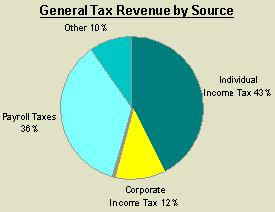
According to data from the Tax Policy Center I calculated that between 2003 and 2007 the corporate income tax totaled about 12% of all federal tax revenue. It is more volatile than other forms and ranged from a paltry 7.4% of revenues in 2003 to a high of 14.7% in 2007. Corporate profits are likely to be highly cyclical as we go through booms and busts. I created a chart to the left that shows the largest pieces of the tax revenue pie.
How High Would the Income Tax Need to Go?
On average, the revenue from the income tax would need to rise by 27% to replace the Corporate Tax. For example: The highest rate is now 35%. It would need to rise to 44.5% if a pure ratio was used. Remember, this is not a tax hike nor tax cut. I'm aiming to be revenue neutral. The people who own stock are already paying the corporate taxes.

According to data from the Tax Policy Center I calculated that between 2003 and 2007 the corporate income tax totaled about 12% of all federal tax revenue. It is more volatile than other forms and ranged from a paltry 7.4% of revenues in 2003 to a high of 14.7% in 2007. Corporate profits are likely to be highly cyclical as we go through booms and busts. I created a chart to the left that shows the largest pieces of the tax revenue pie.
How High Would the Income Tax Need to Go?
On average, the revenue from the income tax would need to rise by 27% to replace the Corporate Tax. For example: The highest rate is now 35%. It would need to rise to 44.5% if a pure ratio was used. Remember, this is not a tax hike nor tax cut. I'm aiming to be revenue neutral. The people who own stock are already paying the corporate taxes.
Tuesday, July 15, 2008
My Platform to Revive the Republican Party
Frustration with the government has reached an all time high. Rasmussen recently released a poll that showed that the number of people who believed that Congress was doing a good or excellent job fell to a mere 9%. The lowest in the history of their polling. Neither side seems to be able to get anything done. Republicans were accomplishing very little and the Democrats seem to be biding their time hoping that this next election will give them large majorities and the White House.
The huge mistake that Republicans made when they were in power was kowtowing to special interest groups, giving unequal tax, and regulatory advantage to their supporters. The Democrats swept into power with a little idealistic fervor to change all this, but they too have succumbed to the same pressures. They let their union devotion shut down a very good trade bill with our ally in Colombia, and their anger towards “Republican” Big Oil has stopped them from easing our price problems with gasoline. Neither party has the muster to stop these bad habits.
It is not merely a problem with politicians, it is a problem with the power that we have given them. Anyone who is given a position of authority where they can help themselves, their friends or their ideology with other people’s money will be tempted to do so. This is the human condition. The only solution is to limit that authority.
Here are my 3 plans –
Ban Earmarks – Craft a bill that prevents any Congressman from submitting a bill or addition to a bill suggesting an allocation of funds to any specific organization or geographic local. A Congressman can not be bribed or cajoled to offer funds when he does not have the authority to do so. Lobbying of Congress would fall significantly.
Enact a Flat Tax – The shorter the tax code the more transparent it becomes. Having a flat tax that offers few or no deductions would stop the lobbying for special tax treatment by numerous groups. Right now the tax code punishes the new wealth accumulation at the highest tax rates, but the myriad deductions help shelter those who are trying to preserve their wealth. Lobbying of Congress to offer tax breaks for this person, but not that person would disappear.
Scrap the Corporate Income Tax – When ExxonMobil makes $40 Billion a year, their tax bill without deductions and account techniques would have been $21.5 Billion at the current 35% tax on profits. This gives a huge incentive for every corporation on earth to hire an army of accountants to cut this amount down. It also gives them a huge incentive to hire an army of lobbyists to fight for tax deductions and favorable tax accounting techniques. The income from the corporate tax should be shifted to the individual taxpayer. Wealthier individuals own more stock so their burden should be higher than those with less income so that each income group pays as close to what they already effectively pay right now. When this is done, corporate lobbying will drop precipitously.
We must take away the power of Congress to hand out money. We must take away the power of lobbyists to affect the tax code. We must take away the power of special interest groups to prosper at the expense of others. Our Congress should be focused on issues of importance not the appeasement of well-financed beggars.
The Republican Party was embarrassed out of office by too many scandals. Before we can hope to regain power and regain the public trust, we must cut off the supply of money. Legislators can not fall into corruption if they lack the power to hand out money.
Ban Earmarks, Enact a Flat Tax, and Scrap the Corporate Income Tax
The huge mistake that Republicans made when they were in power was kowtowing to special interest groups, giving unequal tax, and regulatory advantage to their supporters. The Democrats swept into power with a little idealistic fervor to change all this, but they too have succumbed to the same pressures. They let their union devotion shut down a very good trade bill with our ally in Colombia, and their anger towards “Republican” Big Oil has stopped them from easing our price problems with gasoline. Neither party has the muster to stop these bad habits.
It is not merely a problem with politicians, it is a problem with the power that we have given them. Anyone who is given a position of authority where they can help themselves, their friends or their ideology with other people’s money will be tempted to do so. This is the human condition. The only solution is to limit that authority.
Here are my 3 plans –
Ban Earmarks – Craft a bill that prevents any Congressman from submitting a bill or addition to a bill suggesting an allocation of funds to any specific organization or geographic local. A Congressman can not be bribed or cajoled to offer funds when he does not have the authority to do so. Lobbying of Congress would fall significantly.
Enact a Flat Tax – The shorter the tax code the more transparent it becomes. Having a flat tax that offers few or no deductions would stop the lobbying for special tax treatment by numerous groups. Right now the tax code punishes the new wealth accumulation at the highest tax rates, but the myriad deductions help shelter those who are trying to preserve their wealth. Lobbying of Congress to offer tax breaks for this person, but not that person would disappear.
Scrap the Corporate Income Tax – When ExxonMobil makes $40 Billion a year, their tax bill without deductions and account techniques would have been $21.5 Billion at the current 35% tax on profits. This gives a huge incentive for every corporation on earth to hire an army of accountants to cut this amount down. It also gives them a huge incentive to hire an army of lobbyists to fight for tax deductions and favorable tax accounting techniques. The income from the corporate tax should be shifted to the individual taxpayer. Wealthier individuals own more stock so their burden should be higher than those with less income so that each income group pays as close to what they already effectively pay right now. When this is done, corporate lobbying will drop precipitously.
We must take away the power of Congress to hand out money. We must take away the power of lobbyists to affect the tax code. We must take away the power of special interest groups to prosper at the expense of others. Our Congress should be focused on issues of importance not the appeasement of well-financed beggars.
The Republican Party was embarrassed out of office by too many scandals. Before we can hope to regain power and regain the public trust, we must cut off the supply of money. Legislators can not fall into corruption if they lack the power to hand out money.
Ban Earmarks, Enact a Flat Tax, and Scrap the Corporate Income Tax
Tuesday, July 1, 2008
Gas Prices - A Comparison of States

Gasbuddy.com has some interesting information on gas prices including a great graphic located here. I put a smaller version on the right. The dark green equates to low gas prices, and the dark red equates with high gas prices. Because prices tend to change dramatically across state lines, I'm willing to bet that state gas taxes, regulations, and mandates are the major contributors to the differences.
South Carolina seems to have the cheapest gas, with Missouri close behind, even though they are not major oil producing or refining states. In the northeast, New Jersey seems to be an island of cheaper gas. What is really striking though is how California is solid dark red. The West Coast has dramatically higher gas prices than the rest of the U.S. In the northeast, New York and Connecticut stand out amongst the rest.
Because you can't read the key at the bottom right here is a list of select states and their average gasoline prices. Source here.
South Carolina - $3.85
Missouri - $3.85
Texas - $3.95
New Jersey - $3.97
Florida - $4.02
Massachusetts - $4.05
New York - $4.25
California - $4.59
California is paying 74 cents more than South Carolina. If your state wants to lower gas prices, they should try to not do what California is doing.
As much as I and other stereotype California's problems stemming from being more left-wing it doesn't really explain why Massachusetts isn't having such problems. Why California in particular is wracked by crisis after crisis is anyone's guess. Even when compared to other states that get ample media exposure it seems to have far more problems. Perhaps while the Northeast tends to be on the left it has more economic literacy due to it's heavy concentration of financial services.
***Update*******
Mark Perry at his Carpe Diem blog also used this graphic this morning. I suspect that we read the same article that referenced it. In addition, he has a graphic of state gas taxes. Here's the link. Gas taxes in California explain 39.7 of the 74 cent difference between California and South Carolina.
Tuesday, June 17, 2008
Gasoline and Mexico
The Houston Chronicle has an article that adds some information to the policy I proposed a few months ago to exchange more visas and citizenships for liberalization of Mexico's oil industry.
The specific quotes I found interesting were:
"The kick is that the fuel is being refined in the United States and trucked across the border to Mexico, only to be sold at prices subsidized by the government..."
"So even while the nation still exports crude oil, it imports about 40 percent of its fuel."
Mexico, because it refuses to allow American investment in their oil industry, does not have the refining capability or technology to produce their own gasoline. This demand for gasoline likely drives up the price of gasoline in the U.S. My policy proposal would fix this.
Mexico's subsidization of gasoline also leads its citizens to consume more gasoline than if the price were allowed to float in the market. This decrease in consumption would lead to less consumption of gasoline from the United States. It would also decrease the demand on crude oil.
One way to lower gas prices is to offer Mexico incentives to allow American investment in their energy industry and drop their subsidization of gasoline. Offering more avenues of immigration can be this incentive.
The specific quotes I found interesting were:
"The kick is that the fuel is being refined in the United States and trucked across the border to Mexico, only to be sold at prices subsidized by the government..."
"So even while the nation still exports crude oil, it imports about 40 percent of its fuel."
Mexico, because it refuses to allow American investment in their oil industry, does not have the refining capability or technology to produce their own gasoline. This demand for gasoline likely drives up the price of gasoline in the U.S. My policy proposal would fix this.
Mexico's subsidization of gasoline also leads its citizens to consume more gasoline than if the price were allowed to float in the market. This decrease in consumption would lead to less consumption of gasoline from the United States. It would also decrease the demand on crude oil.
One way to lower gas prices is to offer Mexico incentives to allow American investment in their energy industry and drop their subsidization of gasoline. Offering more avenues of immigration can be this incentive.
Tuesday, June 3, 2008
Explaining the Gold Standard
During the Republican primaries, Rep. Ron Paul talked at length about the need to return to the Gold Standard. Steve Forbes, former Republican Candidate for President and publisher of Forbes Magazine has mentioned recently his desire to return to the Gold Standard. What exactly is the Gold Standard and what are its advantages?
From what I have read, there are generally two definitions of a gold standard. Most people think of the gold standard being when the currency is backed by gold. That is, every dollar bill is effectively a voucher for gold. If you desired, you could go down to the Federal Reserve Bank nearest you and exchange your dollar for some amount of gold printed on the bill. This is the 100% reserve gold standard. Every dollar promises to be exchangeable for a certain amount of gold, and the government would have on hand, that amount of gold. This is the kind of gold standard supported by Ron Paul, although he supports this through privately printed currencies, which I will not go into now.
Another kind of gold standard is merely pegging the dollar to a certain price of gold. Currently the price of gold is around $880. If we pegged the dollar to $880/oz., the Federal Reserve would simply print or destroy dollars until the price of gold moved back towards the pegged price of $880/oz. If the price of gold went up to $900/oz. this would imply that there too many dollars out there. The Federal Reserve would print fewer dollars and start destroying older ones. If the price of gold went down to $860/oz. this would imply that there are too few dollars. At that point, the Fed would start printing dollars to move the price back up. Under a dollar pegged to gold, the government does not actually have to hold any gold.
The downside to the 100% reserve gold standard is holding the enormous amount of gold and trying to set the value of the dollar. There is an enormous amount of currency in the United States and we do not currently have enough gold to back all of it. The adjustment period between our current system and this system could be traumatic, as prices would swing significantly. However, under a dollar pegged to gold, this is not a problem. As long as the dollar is pegged at a price of gold near its current price, the transition should be a seamless one.
Why a Gold Standard?
Recently, the dollar has been losing an immense amount of value. A number of economists (but I would not say the majority) believe that most of the rise in the price of oil and other commodities is because of a weak dollar. When the dollar is weak, it buys fewer imported foreign goods. Most oil has to be imported, thus the rising price. The dollar loses value when the Federal Reserve increases our money supply faster than other countries. I feel that this likely explains about half of the rise in oil prices, but that is just a gut feeling.
The amount of gold in the world is slowly increasing, and no new massive supplies are expected to be found. Because the supply of gold is stable, pegging the value of the dollar to gold would generally lead to a stable supply of money. A stable supply of money would mean little inflation and less risk for investments. More certainty leads to a better allocation of resources and more economic growth.
A Gold Standard prevents the Federal Reserve from arbitrarily creating new money. Congress has given the Fed authority to fight inflation, maximize employment, and smooth out economic panics. It needs to be pointed out that the Fed only tries to do this, and often does not succeed. In my opinion, the Fed makes far too many mistakes, not out of incompetence, but from the impossibility of herding the financial behavior of 300 million Americans.
Historically, while the U.S. was under a Gold Standard, interest rates stayed low and long-term inflation was virtually non-existent. Some economists do not like a dollar peg for the sole reason that it limits the government’s ability to “fix” the economy. I find little proof that they are very adept at this.
I am still learning and reading on this topic, but I feel comfortable stating that I support pegging the dollar to a certain price of gold. In recent years, the Fed has caused a number of problems by trying to do too many things. Discipline and stability need to be reestablished, and a gold standard pegging the dollar to a certain price of gold would be a great help.
From what I have read, there are generally two definitions of a gold standard. Most people think of the gold standard being when the currency is backed by gold. That is, every dollar bill is effectively a voucher for gold. If you desired, you could go down to the Federal Reserve Bank nearest you and exchange your dollar for some amount of gold printed on the bill. This is the 100% reserve gold standard. Every dollar promises to be exchangeable for a certain amount of gold, and the government would have on hand, that amount of gold. This is the kind of gold standard supported by Ron Paul, although he supports this through privately printed currencies, which I will not go into now.
Another kind of gold standard is merely pegging the dollar to a certain price of gold. Currently the price of gold is around $880. If we pegged the dollar to $880/oz., the Federal Reserve would simply print or destroy dollars until the price of gold moved back towards the pegged price of $880/oz. If the price of gold went up to $900/oz. this would imply that there too many dollars out there. The Federal Reserve would print fewer dollars and start destroying older ones. If the price of gold went down to $860/oz. this would imply that there are too few dollars. At that point, the Fed would start printing dollars to move the price back up. Under a dollar pegged to gold, the government does not actually have to hold any gold.
The downside to the 100% reserve gold standard is holding the enormous amount of gold and trying to set the value of the dollar. There is an enormous amount of currency in the United States and we do not currently have enough gold to back all of it. The adjustment period between our current system and this system could be traumatic, as prices would swing significantly. However, under a dollar pegged to gold, this is not a problem. As long as the dollar is pegged at a price of gold near its current price, the transition should be a seamless one.
Why a Gold Standard?
Recently, the dollar has been losing an immense amount of value. A number of economists (but I would not say the majority) believe that most of the rise in the price of oil and other commodities is because of a weak dollar. When the dollar is weak, it buys fewer imported foreign goods. Most oil has to be imported, thus the rising price. The dollar loses value when the Federal Reserve increases our money supply faster than other countries. I feel that this likely explains about half of the rise in oil prices, but that is just a gut feeling.
The amount of gold in the world is slowly increasing, and no new massive supplies are expected to be found. Because the supply of gold is stable, pegging the value of the dollar to gold would generally lead to a stable supply of money. A stable supply of money would mean little inflation and less risk for investments. More certainty leads to a better allocation of resources and more economic growth.
A Gold Standard prevents the Federal Reserve from arbitrarily creating new money. Congress has given the Fed authority to fight inflation, maximize employment, and smooth out economic panics. It needs to be pointed out that the Fed only tries to do this, and often does not succeed. In my opinion, the Fed makes far too many mistakes, not out of incompetence, but from the impossibility of herding the financial behavior of 300 million Americans.
Historically, while the U.S. was under a Gold Standard, interest rates stayed low and long-term inflation was virtually non-existent. Some economists do not like a dollar peg for the sole reason that it limits the government’s ability to “fix” the economy. I find little proof that they are very adept at this.
I am still learning and reading on this topic, but I feel comfortable stating that I support pegging the dollar to a certain price of gold. In recent years, the Fed has caused a number of problems by trying to do too many things. Discipline and stability need to be reestablished, and a gold standard pegging the dollar to a certain price of gold would be a great help.
Subscribe to:
Posts (Atom)