


Dr. Alan Parks, MD, is the founder of Americans for a Balanced Budget Amendment. He sent me an e-mail notifying me of his new website. I perused for a bit, and found it worth mentioning. He's already gathered an endorsement from noted personal finance guru Dave Ramsey.
Dr. Parks ran across this post of mine in support of a balanced budget amendment. I tend to channel William Buckley when I'm emotional, as my vocabulary soars above my standard typo ridden fare. Looking back at it, I'm still pleased with it.
At any rate, check out Americans for a Balanced Budget Amendment, and lend your support.
Showing posts with label taxes. Show all posts
Showing posts with label taxes. Show all posts
Monday, April 20, 2009


Wednesday, February 25, 2009
Be Careful Not to Exaggerate
I am a believer in supply-side economics, but sometimes conservatives exaggerate its effects. There’s a little bit of this exaggeration in the criticisms I've read of the new Obama tax plan. Don’t get me wrong, it’s a bad idea and will only lead to less economic growth, but we are not going to plunge into a second recession from it alone.
From what I have read there are three major anti-growth tax changes that Obama wants to implement. First, is a hike in the marginal income tax rate for evil rich people. Not only do higher marginal provide a disincentive to work, but it also leads to less capital accumulation. The rate change, at least proposed, will move the highest marginal rate from 35% to 39.6%. If this were shooting up above 70% like under the Carter administration this would be a major concern. But, as is, it is only a slight negative effect.
Secondly, is the hike in the Capital Gains tax. This is the most moronic of all the tax hikes, as history has shown that cutting them down to 15% actually raised government revenue. This will have a more significant negative effect on capital flow into and out of the United States. However, changes in investment do not lead to immediate changes in the economy. This will be a long-term drag on the economy overall. However, the effects will be more immediate in the stock market.
Lastly, is forcing hedge funds to pay the corporate income tax rate instead of just the capital gains tax rate. Effectively what this says is that if you are an individual who invests one’s own money, you can pay the lower capital gains tax (15% soon to be 20%), but if you and your friends go into together you are now a corporation that needs to pay the higher corporate rate of 35%.
These changes are bad and they will lead to less economic growth, but the results will slowly build over time. If we were more sensitive to the tax competition they have in Europe the effects would be much bigger, but I don't think we are as sensitive to globalization as some would imagine.
Think of supply-side tax cuts this way: It’s like dieting. Cutting out the chips and sodas will lead to weight loss, but don’t expect to wake up the next morning looking like Brad Pitt.
Or the converse: It’s like me in college. I start off 5’11” and 130 lbs. As a carefree freshman, I laugh off suggestions about weight gain as I consume massive quantities of sodas, chips, and rolls of Pillsbury cookie dough. By the end of my sophomore year I’m pushing 175. Tax hikes always catch up to you, but only drastic changes show up quickly.
From what I have read there are three major anti-growth tax changes that Obama wants to implement. First, is a hike in the marginal income tax rate for evil rich people. Not only do higher marginal provide a disincentive to work, but it also leads to less capital accumulation. The rate change, at least proposed, will move the highest marginal rate from 35% to 39.6%. If this were shooting up above 70% like under the Carter administration this would be a major concern. But, as is, it is only a slight negative effect.
Secondly, is the hike in the Capital Gains tax. This is the most moronic of all the tax hikes, as history has shown that cutting them down to 15% actually raised government revenue. This will have a more significant negative effect on capital flow into and out of the United States. However, changes in investment do not lead to immediate changes in the economy. This will be a long-term drag on the economy overall. However, the effects will be more immediate in the stock market.
Lastly, is forcing hedge funds to pay the corporate income tax rate instead of just the capital gains tax rate. Effectively what this says is that if you are an individual who invests one’s own money, you can pay the lower capital gains tax (15% soon to be 20%), but if you and your friends go into together you are now a corporation that needs to pay the higher corporate rate of 35%.
These changes are bad and they will lead to less economic growth, but the results will slowly build over time. If we were more sensitive to the tax competition they have in Europe the effects would be much bigger, but I don't think we are as sensitive to globalization as some would imagine.
Think of supply-side tax cuts this way: It’s like dieting. Cutting out the chips and sodas will lead to weight loss, but don’t expect to wake up the next morning looking like Brad Pitt.
Or the converse: It’s like me in college. I start off 5’11” and 130 lbs. As a carefree freshman, I laugh off suggestions about weight gain as I consume massive quantities of sodas, chips, and rolls of Pillsbury cookie dough. By the end of my sophomore year I’m pushing 175. Tax hikes always catch up to you, but only drastic changes show up quickly.
Wednesday, December 31, 2008
A Gas Tax Salve for Housing Prices
I have previously written my skepticisms on raising the gas tax. Economist Greg Mankiw views it as a Pigovian Tax to help reach environmental social goals. I think that the environmental advantages are overblown as we saw only minor reductions in gasoline consumption when prices went up to $4.00.
However, given my skepticism, there is another social goal that can be achieved without violating my libertarian principals. If states were to increase gas taxes and in exchange lower property taxes this should help increase demand for homes.
However, given my skepticism, there is another social goal that can be achieved without violating my libertarian principals. If states were to increase gas taxes and in exchange lower property taxes this should help increase demand for homes.
I'm not sure what the total property tax revenue for California is, and their rate averages a pretty low 4.77/$1000 of valuation, but if you estimate that the average home is worth $400,000 in the state, then eliminating property taxes would save the average home owner a little over $1,900/year, or $158/month. Assuming 3.5 people per house, this means about 10 million homes, and thus $19 Billion in lost revenue.
On the gas tax revenue side we can again use some approximations. Americans use 390 million gallons of gasoline per day. If we assume California uses 1/8th, since they have about 1/8th of the population this equals 48.75 million gallons per day. Multiply by 365 days and you get around 17.8 billion gallons per year. If California were to charge a new tax of a dollar per gallon this would lead to around $17 Billion in revenue (assuming a slight decrease in driving).
This back of the envelope estimation might not be perfectly accurate, but it looks like the gasoline tax could help eliminate property taxes in the state. Getting rid of property taxes would make homes cheaper, but not lower their face value (sales price). It should help offset some downward pressure on home prices without the moral hazard problems of bailing them out. It also seems politically feasible given the "green" inclinations of the party in power.
Saturday, December 20, 2008
Explaining the Laffer Curve
If you have ever wondered what the Laffer Curve is or what makes people like me believe that if we raise capital gains taxes, like Obama pushed in the election, tax revenues will fall, then watch this video. You can also go to Center for Freedom and Prosperity and watch all three in their series.
Update - screw it, I can't get the embedding progrmaming to workright. Click here
Update - screw it, I can't get the embedding progrmaming to workright. Click here
Wednesday, December 10, 2008
I Have a Man-Crush
According to this story with The State, a South Carolina newspaper, (HT: Club for Growth), the governor of that state, Mark Sanford, wants to do the following:
1. Eliminate state Corporate Income Tax
2. Pay for it by eliminating Corporate Welfare tax breaks for politically desireable industries.
3. Switch the codified state income tax for a Flat Tax
Isn't he just dreamy. Maybe my wife would let me put his poster on the closet door.

Wednesday, December 3, 2008
Supply Side Stimulus
Richard Rahn of the Cato Institute outlines an economic restoration plan in an op-ed for the Washington Times today. He also bashes the “Keynesian claptrap”, which is always fun. I liked some of the proposal, so I wanted to expound on it.
1. Cut payroll taxes for two years – Payroll taxes are the FICA and Medicare taxes removed from your paycheck. Of these taxes, you pay half and your employer pays half. By cutting this tax, tax home pay for the employee increases and employment costs for the employer fall. This should give more incentive to hire.
However, because the tax cut is temporary the effects will be small. It is unlikely to see much increase in demand for professional positions as companies generally expect new professional hires to spend several years at the firm. The unemployment rate for college educated people is also generally very low (~2%) and doesn’t tend to spike as much during recessions.
For low-skill labor this could be a boon. Unemployment rates for low-skill labor is often quite high (~8%) and tends to jump quite a bit during recessions relative to other labor demographics. Employers who simply need warm bodies don’t expect that these employees will make a career of flipping burgers. This temporary measure could have a worthwhile impact to alleviate temporarily unemployment.
Given that there are some benefits, this would be a less bad stimulus than direct government spending. The tax cut encourages more output, and allows businesses to allocate efficiently the resources to profitable ends. The drawback is that it still requires borrowing, which gives incentives to move capital from its most efficient allocation to one less so. It may help your local Jack in the Box, but only at the expense of your local biotech startup looking for a loan. I just don’t think there are enough positive supply-side effects from this kind of tax cut to mitigate this fact.
I say "less bad stimulus" than government direct spending because of the points that Mr. Rahn makes:
The other effects of cutting the corporate tax rate that I like are gains in efficiency and drops in lobbying. If companies are paying less corporate taxes there is less incentive for them to engage in creative tax accounting. These people and resources could be employed in more productive tasks. In a similar way, lower tax rates gives less incentive to game the tax code through lobbyists.
It would still require borrowing to replace this tax revenue, but I think there are enough supply-side effects to make this worth doing.
3. Assuring the market that capital gains taxes will not be increased – This costs nothing and would help our ailing stock markets. Some of the market drop is based on fears of Mr. Obama’s campaign pledges to increased capital gains taxes. The capital gains tax is by far the most destructive form of taxation the government imposes. History has shown that raising this tax actually lowers tax revenue, and drags down economic growth by destroying capital. Higher capital gains taxes are a lose-lose proposition.
Mr. Rahn also encourages allowing individuals to reclaim taxes through capital losses. I completely disagree. This would exacerbate the already pro-cyclical nature of tax revenues. It would be better just to get rid of them.
In general, good ideas. I have toyed with the payroll tax cut before, but it doesn’t look like a panacea. So, I shrug my shoulders at the payroll tax cut, and give a big thumbs up to cutting corporate tax rates and maintaining current capital gains taxes.
1. Cut payroll taxes for two years – Payroll taxes are the FICA and Medicare taxes removed from your paycheck. Of these taxes, you pay half and your employer pays half. By cutting this tax, tax home pay for the employee increases and employment costs for the employer fall. This should give more incentive to hire.
However, because the tax cut is temporary the effects will be small. It is unlikely to see much increase in demand for professional positions as companies generally expect new professional hires to spend several years at the firm. The unemployment rate for college educated people is also generally very low (~2%) and doesn’t tend to spike as much during recessions.
For low-skill labor this could be a boon. Unemployment rates for low-skill labor is often quite high (~8%) and tends to jump quite a bit during recessions relative to other labor demographics. Employers who simply need warm bodies don’t expect that these employees will make a career of flipping burgers. This temporary measure could have a worthwhile impact to alleviate temporarily unemployment.
Given that there are some benefits, this would be a less bad stimulus than direct government spending. The tax cut encourages more output, and allows businesses to allocate efficiently the resources to profitable ends. The drawback is that it still requires borrowing, which gives incentives to move capital from its most efficient allocation to one less so. It may help your local Jack in the Box, but only at the expense of your local biotech startup looking for a loan. I just don’t think there are enough positive supply-side effects from this kind of tax cut to mitigate this fact.
I say "less bad stimulus" than government direct spending because of the points that Mr. Rahn makes:
Some advocate government spending on infrastructure as part of a stimulus package. In theory, government infrastructure spending (highways, bridges, dams, etc.) can help the economy: if the project meets a solid cost-benefit test; if it is well-managed; if there is little or no corruption; and if it can be done quickly to help the current downturn. Do you want to bet your tax dollars on all of those "ifs"?2. Cutting Corporate Income tax – This idea I can more whole-heartedly support. First, and foremost, we would become more competitive internationally. In the long run, more operations would be located here in the United States. Sure there are countries who have labor so cheap that we can not compete for the lowest skill jobs, but we can compete for high wage/high skill jobs. As Europe continues to cut their corporate tax rates, it will become more and more pressing for the U.S. to do the same. Secondly, there is an immediate benefit. My company has (legally) arranged business operations to move profits out of Japan to the United States to save on taxes. We have done the same to move profits from the U.S. to other low tax countries. If those profits were repatriated, the tax flows would stay in our country and no theirs.
The other effects of cutting the corporate tax rate that I like are gains in efficiency and drops in lobbying. If companies are paying less corporate taxes there is less incentive for them to engage in creative tax accounting. These people and resources could be employed in more productive tasks. In a similar way, lower tax rates gives less incentive to game the tax code through lobbyists.
It would still require borrowing to replace this tax revenue, but I think there are enough supply-side effects to make this worth doing.
3. Assuring the market that capital gains taxes will not be increased – This costs nothing and would help our ailing stock markets. Some of the market drop is based on fears of Mr. Obama’s campaign pledges to increased capital gains taxes. The capital gains tax is by far the most destructive form of taxation the government imposes. History has shown that raising this tax actually lowers tax revenue, and drags down economic growth by destroying capital. Higher capital gains taxes are a lose-lose proposition.
Mr. Rahn also encourages allowing individuals to reclaim taxes through capital losses. I completely disagree. This would exacerbate the already pro-cyclical nature of tax revenues. It would be better just to get rid of them.
In general, good ideas. I have toyed with the payroll tax cut before, but it doesn’t look like a panacea. So, I shrug my shoulders at the payroll tax cut, and give a big thumbs up to cutting corporate tax rates and maintaining current capital gains taxes.
Sunday, November 23, 2008
A Minor Victory
From James Pethokoukis' Blog at US News & World Report - here.
Note - It also means that I was wrong on #3 of this post.
It now looks like Obama will not propose raising taxes next year, instead waiting for the end-of-2010 expiration of the 2001 and 2003 tax cuts. I guess this means he believes, on some level, that raising taxes hurts economic growth. So I guess it really was about "fairness" all along. I think every economic initiative for years to come will be graded according to whether or not it boost the economy . Go long "growth," go short "fairness."Of course, this means the deficit will be even bigger. However, it does prevent further erosion in the economy. So in total, this is change that I can believe in.
Note - It also means that I was wrong on #3 of this post.
Wednesday, November 19, 2008
Europe is Cutting Taxes on the Wealthy
Steven Malanga is one of my favorite columnists. He consistently provides much more meaty data than other economic writers with bigger reputations.
His column today, sums up the reality that much of the rest of the world is not planning on raising taxes on the wealthy like Barack Obama, they are cutting them. They are not moving to more progressive tax systems, but flat taxes.
The tax-cutting binge is taking place in what some have called “Old Europe.” France, Germany, Italy, and Spain have cut their top personal income tax rates since 2003. Germany, Italy, Spain and the U.K., meanwhile, have trimmed corporate tax rates, too, in just the past year.
Driving the Western European governments is aggressive tax policy in New Europe, that is, Eastern European countries, which are competing for workers and investment. Many of these countries had the opportunity to design their own tax systems after the fall of the Soviet Union and they have often opted for tax schemes that are simpler than the U.S. or Western European systems. Many feature only a few tax brackets and a few are flat tax schemes. Bulgaria has a new flat tax rate of 10 percent, down from a top tax rate of 29 percent in 2004. Estonia has cut its flat tax rate to 21 percent from 26 percent, while the Slovak Republic has trimmed its top rate from 38 percent to a flat tax rate of 19 percent. Romania has eliminated its top rate of 40 percent and gone to a flat tax of 16 percent.
In Asia-Pacific, Hong Kong’s low taxes (top rate, 16 percent) have continued to make it a magnet for both people and money and prompted tax cuts in other countries. Australia cut its top income tax rate two percentage points to 45 percent to try and lure back talent fleeing to Hong Kong and Singapore, but Australia has a long way to go to be competitive. Singapore has countered by slashing its top rate to 20 percent from 22 percent.
How embarrassing that we have regressed into the past.
Monday, October 6, 2008
2009 State Business Tax Climate Index
The Tax Foundation recently put out their annual state business tax climate index. I reproduced a graphic found in the pdf that sums up the findings.


HT: Club for Growth
Tuesday, September 2, 2008
Time to Eliminate the Federal Gas Tax
The Federal Gas Tax must go. It is part of the rent-seeking bog that has mired our Congress in excessive spending, and provides the murkiest pool of funds for pork barrel projects. It serves virtually no national interest and it wastes the time of lawmakers and federal officials.
I am not proposing a tax cut. I would fully expect most every state to increase their gas taxes to make up for the lost funds from federal transportation outlays. The point is for individual states to make decisions on transportation spending, and remove the bulk of funds that Congress hands out with a wink and a nod to friends, donors, and the well connected.
Many have attacked earmarks with good cause, but there are still those that defend them. The defenses go something like this:
“I was sent to Congress to fight for my state/district and make sure we get our fair share of federal funds”
or
“The citizens in my state/district would rather have their elected officials work for them instead of relying on some bureaucrat”
Should individual states get their fair share of gas tax revenue? Yes, by never sending the money to Washington in the first place.
Who should decide how gas tax revenue in Delaware be spent? The people of Delaware. If Oklahoma wants to build freeways, then let them use their own money. If Oregon wants no freeways and only light rail, then let them use their own money. Funding should not be based on the seniority of a state’s congressional delegation. It should be decided with the reasonable judgment of those who are most familiar with state transportation needs: The State governments.
The bumbling bureaucrats and the arcane funding formulas give incentives for every state and city to maximize their funding by kowtowing to the rules and not strictly looking out for the interests of their local citizens. If these defenders of pork are right, state governments would be vastly superior at appropriating gas tax funds than the federal government. When a state government is using their own money there will be far fewer “Bridges to Nowhere”. It is only when they are trying to game the system that idiotic projects of that ilk are enacted.
Federal Gas Tax dollars are a cesspool of corruption. They waste time and misappropriate transportation dollars around the country. The Federal Gas Tax must go!
I am not proposing a tax cut. I would fully expect most every state to increase their gas taxes to make up for the lost funds from federal transportation outlays. The point is for individual states to make decisions on transportation spending, and remove the bulk of funds that Congress hands out with a wink and a nod to friends, donors, and the well connected.
Many have attacked earmarks with good cause, but there are still those that defend them. The defenses go something like this:
“I was sent to Congress to fight for my state/district and make sure we get our fair share of federal funds”
or
“The citizens in my state/district would rather have their elected officials work for them instead of relying on some bureaucrat”
Should individual states get their fair share of gas tax revenue? Yes, by never sending the money to Washington in the first place.
Who should decide how gas tax revenue in Delaware be spent? The people of Delaware. If Oklahoma wants to build freeways, then let them use their own money. If Oregon wants no freeways and only light rail, then let them use their own money. Funding should not be based on the seniority of a state’s congressional delegation. It should be decided with the reasonable judgment of those who are most familiar with state transportation needs: The State governments.
The bumbling bureaucrats and the arcane funding formulas give incentives for every state and city to maximize their funding by kowtowing to the rules and not strictly looking out for the interests of their local citizens. If these defenders of pork are right, state governments would be vastly superior at appropriating gas tax funds than the federal government. When a state government is using their own money there will be far fewer “Bridges to Nowhere”. It is only when they are trying to game the system that idiotic projects of that ilk are enacted.
Federal Gas Tax dollars are a cesspool of corruption. They waste time and misappropriate transportation dollars around the country. The Federal Gas Tax must go!
Wednesday, July 23, 2008
More Reasons for My Plan
Admidst an article by Steven Malanga at Real Clear Markets, are some good reasons to support my emphasis on ditching the corporate income tax and passing a flat tax.
On the Corporate Tax:
"Our corporate tax rate is now so high and uncompetitive that even re-destributive types like Charlie Rangel, chair of the House Ways and Means Committee, think it should be lowered. Our adjusted federal and average state corporate tax rate, at 39.27 percent, is higher than 28 out of 29 Organisation of Economic Co-operation and Development (OECD) members. In 24 states, including California, New Jersey, Massachusetts, Pennsylvania and New York, the combined federal-local tax rate is higher than in any other OECD country"
On the Income Tax:
By contrast, 24 countries around the world have now gone in the opposite direction, employing simple flat-tax schemes with no loopholes for special interests and no double taxation in the form of capital gains or estate taxes.
On the Corporate Tax:
"Our corporate tax rate is now so high and uncompetitive that even re-destributive types like Charlie Rangel, chair of the House Ways and Means Committee, think it should be lowered. Our adjusted federal and average state corporate tax rate, at 39.27 percent, is higher than 28 out of 29 Organisation of Economic Co-operation and Development (OECD) members. In 24 states, including California, New Jersey, Massachusetts, Pennsylvania and New York, the combined federal-local tax rate is higher than in any other OECD country"
On the Income Tax:
By contrast, 24 countries around the world have now gone in the opposite direction, employing simple flat-tax schemes with no loopholes for special interests and no double taxation in the form of capital gains or estate taxes.
Friday, July 18, 2008
The Freedom Game
The plan I have detailed over the last few days may not sound revolutionary, but there is a method to my madness. If we are going to have a free market, we must trust that the government isn’t going to change the rules to benefit others over ourselves. In review, the three points are: Ban Earmarks, Enact a Flat Tax, Transfer the Corporate Tax to the Income Tax.
In economics, there is a branch of research called Game Theory. The classic example of this is the Prisoner’s Dilemma.

Looking at the table above, we have two prisoners who committed a felony, let us say armed robbery, but neither has been convicted yet, merely arrested. Both prisoners are put into separate interrogation rooms. If they both stayed silent, they could both serve 6 months in jail because the evidence is not a slam-dunk. However, the cops start to lean on them and tell them that their accomplice is starting to talk. If Prisoner B rats he goes free, and Prisoner A gets 10 years. The same is true if Prisoner A rats. If your “friend” is willing to rob a bank, how likely is it that he would not lie to stay out of prison? Both prisoners panic, and both rat on each other. Both go to prison for 5 years. This happens quite often in the real world and has been a police interrogation technique for a very long time.
We would like to think that loyalty would win out, but the consequences are just too big most of the time. When this game is repeated over and over again, the game changes, it is called a Repeated Game. Very creative right? Because the prisoners know that they are going to have to trust each other many times, they stick by their friend and don’t rat out as easily.
How does this relate to Capitalism?
While I wish that everyone could be an economist, I know this is not possible. Most who support the free market simply trust that they are being treated fairly and that people in society are receiving only the fruits of their ideas, investments, or labor. Let me reiterate an economic definition that I used on my blog a few days ago: Rent Seeking. According to Wikipedia, “In economics, rent seeking occurs when an individual, organization or firm seeks to make money by manipulating the economic and/or legal environment rather than by trade and production of wealth.” More specifically, this includes tax breaks, special contracts, welfare checks, and other special treatments.
When one group receives these kinds of rents, a.k.a. Free Money, we lose trust that we are being treated equally and envy leads other groups to seek their own rents. The best solution is to take away their rents, as I have proposed, but unfortunately, our system has made it much easier to seek rents then to remove them. It has become a game like the prisoner’s dilemma. Here is a new illustration depicting this problem.

In economics, there is a branch of research called Game Theory. The classic example of this is the Prisoner’s Dilemma.

Looking at the table above, we have two prisoners who committed a felony, let us say armed robbery, but neither has been convicted yet, merely arrested. Both prisoners are put into separate interrogation rooms. If they both stayed silent, they could both serve 6 months in jail because the evidence is not a slam-dunk. However, the cops start to lean on them and tell them that their accomplice is starting to talk. If Prisoner B rats he goes free, and Prisoner A gets 10 years. The same is true if Prisoner A rats. If your “friend” is willing to rob a bank, how likely is it that he would not lie to stay out of prison? Both prisoners panic, and both rat on each other. Both go to prison for 5 years. This happens quite often in the real world and has been a police interrogation technique for a very long time.
We would like to think that loyalty would win out, but the consequences are just too big most of the time. When this game is repeated over and over again, the game changes, it is called a Repeated Game. Very creative right? Because the prisoners know that they are going to have to trust each other many times, they stick by their friend and don’t rat out as easily.
How does this relate to Capitalism?
While I wish that everyone could be an economist, I know this is not possible. Most who support the free market simply trust that they are being treated fairly and that people in society are receiving only the fruits of their ideas, investments, or labor. Let me reiterate an economic definition that I used on my blog a few days ago: Rent Seeking. According to Wikipedia, “In economics, rent seeking occurs when an individual, organization or firm seeks to make money by manipulating the economic and/or legal environment rather than by trade and production of wealth.” More specifically, this includes tax breaks, special contracts, welfare checks, and other special treatments.
When one group receives these kinds of rents, a.k.a. Free Money, we lose trust that we are being treated equally and envy leads other groups to seek their own rents. The best solution is to take away their rents, as I have proposed, but unfortunately, our system has made it much easier to seek rents then to remove them. It has become a game like the prisoner’s dilemma. Here is a new illustration depicting this problem.

As long as rent seeking is easy, people will seek rents. As long as rents are given, we will not trust each other and we will seek our own rents. As we seek more rents, the economy will not work as well, there will be fewer jobs, and we will slowly lose our personal freedom. Getting rid of Earmarks, setting up a transparent Flat Tax, and eliminating the Corporate Tax will make rent seeking much more difficult.
Thursday, July 17, 2008
Plan Details - Flat Tax
The flat tax has been around for a while, so many people already understand it, but to avoid any confusion over what I am talking about let me reiterate. The flat tax charges a set percentage rate on income. However, most flat tax proposals only charge the flat tax rate on income above a certain amount. In my graphic below, I assume that noone would pay any tax when their income was below $20,000.
 Other plans have also assumed a single deduction to account for spouses and children. I am not opposed to this and do think that something has to be done to not discriminate against married couples or singles. You may have also have noticed that my marginal tax rate is 24%. Through some research I have found flat tax plans where the marginal rate ranged from 17% to 19%. To be conservative I chose 19%. I also ratioed up the rate to account for the elimination of the corporate income tax.
If some believe that the flat tax is not progressive enough, I am also not opposed to higher marginal rates on higher levels of income, but I would prefer to keep the design as simple as possible. The major point for me of creating a flat tax is to avoid showing favoritism to anyone, and closing the door on rent seeking.
Full Disclosure: I would pay significantly more federal income tax under this plan. My wife does not receive a paycheck, I have two children and a mortgage. I currently pay very little in income taxes.
 Other plans have also assumed a single deduction to account for spouses and children. I am not opposed to this and do think that something has to be done to not discriminate against married couples or singles. You may have also have noticed that my marginal tax rate is 24%. Through some research I have found flat tax plans where the marginal rate ranged from 17% to 19%. To be conservative I chose 19%. I also ratioed up the rate to account for the elimination of the corporate income tax.
If some believe that the flat tax is not progressive enough, I am also not opposed to higher marginal rates on higher levels of income, but I would prefer to keep the design as simple as possible. The major point for me of creating a flat tax is to avoid showing favoritism to anyone, and closing the door on rent seeking.
Full Disclosure: I would pay significantly more federal income tax under this plan. My wife does not receive a paycheck, I have two children and a mortgage. I currently pay very little in income taxes.
Plan Details - Corporate Income Tax
Is Switching the Corporate Tax over to the Income Tax Feasible?
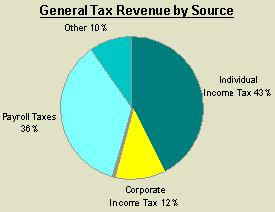
According to data from the Tax Policy Center I calculated that between 2003 and 2007 the corporate income tax totaled about 12% of all federal tax revenue. It is more volatile than other forms and ranged from a paltry 7.4% of revenues in 2003 to a high of 14.7% in 2007. Corporate profits are likely to be highly cyclical as we go through booms and busts. I created a chart to the left that shows the largest pieces of the tax revenue pie.
How High Would the Income Tax Need to Go?
On average, the revenue from the income tax would need to rise by 27% to replace the Corporate Tax. For example: The highest rate is now 35%. It would need to rise to 44.5% if a pure ratio was used. Remember, this is not a tax hike nor tax cut. I'm aiming to be revenue neutral. The people who own stock are already paying the corporate taxes.

According to data from the Tax Policy Center I calculated that between 2003 and 2007 the corporate income tax totaled about 12% of all federal tax revenue. It is more volatile than other forms and ranged from a paltry 7.4% of revenues in 2003 to a high of 14.7% in 2007. Corporate profits are likely to be highly cyclical as we go through booms and busts. I created a chart to the left that shows the largest pieces of the tax revenue pie.
How High Would the Income Tax Need to Go?
On average, the revenue from the income tax would need to rise by 27% to replace the Corporate Tax. For example: The highest rate is now 35%. It would need to rise to 44.5% if a pure ratio was used. Remember, this is not a tax hike nor tax cut. I'm aiming to be revenue neutral. The people who own stock are already paying the corporate taxes.
Tuesday, July 15, 2008
My Platform to Revive the Republican Party
Frustration with the government has reached an all time high. Rasmussen recently released a poll that showed that the number of people who believed that Congress was doing a good or excellent job fell to a mere 9%. The lowest in the history of their polling. Neither side seems to be able to get anything done. Republicans were accomplishing very little and the Democrats seem to be biding their time hoping that this next election will give them large majorities and the White House.
The huge mistake that Republicans made when they were in power was kowtowing to special interest groups, giving unequal tax, and regulatory advantage to their supporters. The Democrats swept into power with a little idealistic fervor to change all this, but they too have succumbed to the same pressures. They let their union devotion shut down a very good trade bill with our ally in Colombia, and their anger towards “Republican” Big Oil has stopped them from easing our price problems with gasoline. Neither party has the muster to stop these bad habits.
It is not merely a problem with politicians, it is a problem with the power that we have given them. Anyone who is given a position of authority where they can help themselves, their friends or their ideology with other people’s money will be tempted to do so. This is the human condition. The only solution is to limit that authority.
Here are my 3 plans –
Ban Earmarks – Craft a bill that prevents any Congressman from submitting a bill or addition to a bill suggesting an allocation of funds to any specific organization or geographic local. A Congressman can not be bribed or cajoled to offer funds when he does not have the authority to do so. Lobbying of Congress would fall significantly.
Enact a Flat Tax – The shorter the tax code the more transparent it becomes. Having a flat tax that offers few or no deductions would stop the lobbying for special tax treatment by numerous groups. Right now the tax code punishes the new wealth accumulation at the highest tax rates, but the myriad deductions help shelter those who are trying to preserve their wealth. Lobbying of Congress to offer tax breaks for this person, but not that person would disappear.
Scrap the Corporate Income Tax – When ExxonMobil makes $40 Billion a year, their tax bill without deductions and account techniques would have been $21.5 Billion at the current 35% tax on profits. This gives a huge incentive for every corporation on earth to hire an army of accountants to cut this amount down. It also gives them a huge incentive to hire an army of lobbyists to fight for tax deductions and favorable tax accounting techniques. The income from the corporate tax should be shifted to the individual taxpayer. Wealthier individuals own more stock so their burden should be higher than those with less income so that each income group pays as close to what they already effectively pay right now. When this is done, corporate lobbying will drop precipitously.
We must take away the power of Congress to hand out money. We must take away the power of lobbyists to affect the tax code. We must take away the power of special interest groups to prosper at the expense of others. Our Congress should be focused on issues of importance not the appeasement of well-financed beggars.
The Republican Party was embarrassed out of office by too many scandals. Before we can hope to regain power and regain the public trust, we must cut off the supply of money. Legislators can not fall into corruption if they lack the power to hand out money.
Ban Earmarks, Enact a Flat Tax, and Scrap the Corporate Income Tax
The huge mistake that Republicans made when they were in power was kowtowing to special interest groups, giving unequal tax, and regulatory advantage to their supporters. The Democrats swept into power with a little idealistic fervor to change all this, but they too have succumbed to the same pressures. They let their union devotion shut down a very good trade bill with our ally in Colombia, and their anger towards “Republican” Big Oil has stopped them from easing our price problems with gasoline. Neither party has the muster to stop these bad habits.
It is not merely a problem with politicians, it is a problem with the power that we have given them. Anyone who is given a position of authority where they can help themselves, their friends or their ideology with other people’s money will be tempted to do so. This is the human condition. The only solution is to limit that authority.
Here are my 3 plans –
Ban Earmarks – Craft a bill that prevents any Congressman from submitting a bill or addition to a bill suggesting an allocation of funds to any specific organization or geographic local. A Congressman can not be bribed or cajoled to offer funds when he does not have the authority to do so. Lobbying of Congress would fall significantly.
Enact a Flat Tax – The shorter the tax code the more transparent it becomes. Having a flat tax that offers few or no deductions would stop the lobbying for special tax treatment by numerous groups. Right now the tax code punishes the new wealth accumulation at the highest tax rates, but the myriad deductions help shelter those who are trying to preserve their wealth. Lobbying of Congress to offer tax breaks for this person, but not that person would disappear.
Scrap the Corporate Income Tax – When ExxonMobil makes $40 Billion a year, their tax bill without deductions and account techniques would have been $21.5 Billion at the current 35% tax on profits. This gives a huge incentive for every corporation on earth to hire an army of accountants to cut this amount down. It also gives them a huge incentive to hire an army of lobbyists to fight for tax deductions and favorable tax accounting techniques. The income from the corporate tax should be shifted to the individual taxpayer. Wealthier individuals own more stock so their burden should be higher than those with less income so that each income group pays as close to what they already effectively pay right now. When this is done, corporate lobbying will drop precipitously.
We must take away the power of Congress to hand out money. We must take away the power of lobbyists to affect the tax code. We must take away the power of special interest groups to prosper at the expense of others. Our Congress should be focused on issues of importance not the appeasement of well-financed beggars.
The Republican Party was embarrassed out of office by too many scandals. Before we can hope to regain power and regain the public trust, we must cut off the supply of money. Legislators can not fall into corruption if they lack the power to hand out money.
Ban Earmarks, Enact a Flat Tax, and Scrap the Corporate Income Tax
Wednesday, April 16, 2008
School Daze
I was reminded this week of how wasteful the public school system is by an article in the Houston Chronicle. Klein Independent School District is trying to pass a bond measure to borrow money for new facilities. Part of the bond package is to replace two existing high schools.
What is the price tag for each high school? Only $130 Million per high school! Each school is supposed to house a close-knit 3,500 students. The schools are full of “necessities”, such as “natatoriums, black-box theaters, dance areas and extensive career and technology programs”. The natatorium is likely an indoor Olympic size swimming pool. A black-box theater allows for special stage productions in addition to a traditional school theater.
Adding to that high price is the fact that the school district already owns the land and it does not include the price of furnishings.
Are these costs out of whack, or is it simply that expensive to build a high school today? How much did schools cost 15 to 20 years ago? What has been the increase in construction costs?
For proper comparison, the price needs to be divided by the number of students the school is expected to educate. It wouldn’t be fair to compare a small town high school to large suburban schools without adjusting for student population. The price per student is around $37,100 for these new high schools.
According to an expert quoted in the article:
“The median cost-per-square-foot of a high school has increased from $104 in 1995 to $171 in 2007, he said. And rates continue to increase as much as 15 percent a year, experts said.”
So, in 1995 this school would have cost $22,600. The article also mentions the price of the high school I attended, Pearland High school, also a suburban Houston school, that was built in 1991. Filling the four year gap between 1991 and 1995, and adding two more years after 2007 to coincide with the actual groundbreaking date with the same rate of construction cost inflation between 1995 and 2007, this implies that my high school should have cost $17,600 per student.
From my memory, my high school was 5A (the largest classification in Texas) and held about 2,400 students my senior year when we started to run out of space. Using these numbers, it implies that my high school should have cost around $42 million.
What was the actual construction price of my high school according to the article? Only $12 million. This means that Klein’s school district has chosen to build these schools 3½ times more extravagant than Pearland did in 1991.
While the Klein High School numbers were rather shocking to me, I did a quick Google search assuming that this could not be the most outrageously expensive high school in America. I was not disappointed.
In suburban Boston, the town of Newton is building a high school for around 2,000 students. According to Boston Globe the costs have spiraled out of control up to $197 million. That is $98,500 per student. That price is just over 2½ times more expensive than Klein’s schools, and a mere 19 times more expensive per student than my high school. Surprisingly enough, the article does not mention any gold plated desks or diamond studded pencils.
The most heinous problem with this out of control spending is where the money is going. The costs for building a simple classroom have not increased so staggeringly. What has gone up is the enormous appetite of school officials for extracurricular facilities. While I have little doubt that all those things are fun for these students, I don’t really understand why the government needs society as a whole to pay for them. Having fun and forming hobbies is not the business of government.
I propose a state law that would limit school construction to having 40% of square footage to academic classroom space. The 40% is just an estimate and may seem high or low, but accounts for the need for hallways, offices, cafeterias, etc… There should also be room for extracurricular activities and vocational classes, but the school should not be dominated by hundreds of thousands of square feet of non-academic building space.
This bond package would include a 16% increase in school property taxes for Klein I.S.D. I complain about taxes, but the only way to keep taxes down is for the government to spend less. When millions of dollars of waste are included in all-or-nothing school bond packages, it puts voters in the unfair position of choosing between preventing waste and having crowded dilapidated schools.
As always, tell me what you think.
What is the price tag for each high school? Only $130 Million per high school! Each school is supposed to house a close-knit 3,500 students. The schools are full of “necessities”, such as “natatoriums, black-box theaters, dance areas and extensive career and technology programs”. The natatorium is likely an indoor Olympic size swimming pool. A black-box theater allows for special stage productions in addition to a traditional school theater.
Adding to that high price is the fact that the school district already owns the land and it does not include the price of furnishings.
Are these costs out of whack, or is it simply that expensive to build a high school today? How much did schools cost 15 to 20 years ago? What has been the increase in construction costs?
For proper comparison, the price needs to be divided by the number of students the school is expected to educate. It wouldn’t be fair to compare a small town high school to large suburban schools without adjusting for student population. The price per student is around $37,100 for these new high schools.
According to an expert quoted in the article:
“The median cost-per-square-foot of a high school has increased from $104 in 1995 to $171 in 2007, he said. And rates continue to increase as much as 15 percent a year, experts said.”
So, in 1995 this school would have cost $22,600. The article also mentions the price of the high school I attended, Pearland High school, also a suburban Houston school, that was built in 1991. Filling the four year gap between 1991 and 1995, and adding two more years after 2007 to coincide with the actual groundbreaking date with the same rate of construction cost inflation between 1995 and 2007, this implies that my high school should have cost $17,600 per student.
From my memory, my high school was 5A (the largest classification in Texas) and held about 2,400 students my senior year when we started to run out of space. Using these numbers, it implies that my high school should have cost around $42 million.
What was the actual construction price of my high school according to the article? Only $12 million. This means that Klein’s school district has chosen to build these schools 3½ times more extravagant than Pearland did in 1991.
While the Klein High School numbers were rather shocking to me, I did a quick Google search assuming that this could not be the most outrageously expensive high school in America. I was not disappointed.
In suburban Boston, the town of Newton is building a high school for around 2,000 students. According to Boston Globe the costs have spiraled out of control up to $197 million. That is $98,500 per student. That price is just over 2½ times more expensive than Klein’s schools, and a mere 19 times more expensive per student than my high school. Surprisingly enough, the article does not mention any gold plated desks or diamond studded pencils.
The most heinous problem with this out of control spending is where the money is going. The costs for building a simple classroom have not increased so staggeringly. What has gone up is the enormous appetite of school officials for extracurricular facilities. While I have little doubt that all those things are fun for these students, I don’t really understand why the government needs society as a whole to pay for them. Having fun and forming hobbies is not the business of government.
I propose a state law that would limit school construction to having 40% of square footage to academic classroom space. The 40% is just an estimate and may seem high or low, but accounts for the need for hallways, offices, cafeterias, etc… There should also be room for extracurricular activities and vocational classes, but the school should not be dominated by hundreds of thousands of square feet of non-academic building space.
This bond package would include a 16% increase in school property taxes for Klein I.S.D. I complain about taxes, but the only way to keep taxes down is for the government to spend less. When millions of dollars of waste are included in all-or-nothing school bond packages, it puts voters in the unfair position of choosing between preventing waste and having crowded dilapidated schools.
As always, tell me what you think.
Wednesday, April 9, 2008
The Pen is Mightier than the Sword
Currently, George Bush has submitted a free trade agreement between Colombia and the United States to Congress for consideration. Because I believe in free trade, I support this bill, but this agreement has more to it than just economics.
Colombia is increasingly an island of freedom. To the east, they share a long border with Venezuela and the increasingly aggressive and socialist Hugo Chavez. To the southwest, they border Ecuador, which is currently led by a Chavez ally and sycophant, Rafael Correa.
For a number of years, Colombia has been fighting the far-left Marxist group known as the FARC. The FARC has been abducting killing hundreds of people a year in their decades-long struggle to turn Colombia into a communist country. Colombia’s current president Álvaro Uribe has won a number of victories against them and has pushed them deep into the jungle. Evidence recently turned up suggesting Hugo Chavez may have given as much as $300 million to support the FARC’s terrorist activities. Hugo Chavez publicly defends the FARC and massed his troops on the border, threatening war, when Colombia briefly crossed into Ecuador to bomb a FARC base.
While Chavez and Correa have been confiscating private property and closing businesses, Colombia has been cutting the size of their government. Their national deficit has shrunk in recent years to acceptable levels.
In a recent op-ed in the Wall Street Journal, Mary Anastasia O’Grady has some other interesting comments during an interview with Colombia’s trade minister Luis Plata.
“No sooner had Luis Plata sat down then he started talking about the Irish economic transformation -- from impoverished ugly duckling to swanky swan of Europe in just two decades -- and why a similar growth model is just what Colombia needs.”
If you recall I talked about the Irish miracle a while back. An excerpt:
“In 1985, the average Irish family made 40% less than their French and German counterparts. Today, because of the massive spending cuts and massive growth from that, the Irish make 40% more than the French and the Germans according to the IMF.”
Mr. Plata went on to say in the interview:
"We starting going to Ireland several years ago, he says, "because we were looking at countries around the world that had been successful in attracting foreign direct investment. What we found was that Ireland had lowered its corporate tax rate from 40% to 12.5%," and as a result "was attracting investment, had lowered tax evasion and had increased tax collection. We went back to Colombia and said, 'why don't we just bring [our corporate rate] from 38% to 12.5%.'"
Apparently, he was only able to get the government to adopt some of these reforms, but some is better than none.
Currently, Colombia is ranked as the 81st richest country in the world. This places them behind Mexico. True poverty is still common. I commend their president for taking a number of political risks for the long-term interests of his people. At the same time, he has successfully beaten back left-wing terrorist groups, but he increasingly faces threats from enemies of the United States.
Yet, the Democratic party has shamefully held up this trade bill. Hillary Clinton recently forced a campaign advisor to resign when it was discovered that he was also consulting in support of this trade agreement. What can we expect though from a party that receives so much money from unions who are against free trade any where, any time, any place for any reason? These choices held by them just do not match my values.
Our ally stands out the door step to a socialist dictator. They give no sympathy. Our ally stands against terrorists who kill and kidnap in hopes of one day installing a communist dictatorship. They give no cheer. Our ally is taking political risks to lift his country out of poverty. They only see a threat to American union membership. Our ally is the best hope and beacon of economic freedom in a darkening South America. They want to embarrass Bush one more time before he leaves office by defeating this bill.
We can show South America that the future is not made of Hugo Chavez’s red banners, and angry militarism. Chavez wants this bill to fail because he knows that Colombia’s success will loosen his grip on power. Tell your congressional representative to sign this free trade bill today, as I have already done. Chavez likes to rattle his saber, so we should unsheathe our pens and sign the bill.
As always, tell me what you think.
Colombia is increasingly an island of freedom. To the east, they share a long border with Venezuela and the increasingly aggressive and socialist Hugo Chavez. To the southwest, they border Ecuador, which is currently led by a Chavez ally and sycophant, Rafael Correa.
For a number of years, Colombia has been fighting the far-left Marxist group known as the FARC. The FARC has been abducting killing hundreds of people a year in their decades-long struggle to turn Colombia into a communist country. Colombia’s current president Álvaro Uribe has won a number of victories against them and has pushed them deep into the jungle. Evidence recently turned up suggesting Hugo Chavez may have given as much as $300 million to support the FARC’s terrorist activities. Hugo Chavez publicly defends the FARC and massed his troops on the border, threatening war, when Colombia briefly crossed into Ecuador to bomb a FARC base.
While Chavez and Correa have been confiscating private property and closing businesses, Colombia has been cutting the size of their government. Their national deficit has shrunk in recent years to acceptable levels.
In a recent op-ed in the Wall Street Journal, Mary Anastasia O’Grady has some other interesting comments during an interview with Colombia’s trade minister Luis Plata.
“No sooner had Luis Plata sat down then he started talking about the Irish economic transformation -- from impoverished ugly duckling to swanky swan of Europe in just two decades -- and why a similar growth model is just what Colombia needs.”
If you recall I talked about the Irish miracle a while back. An excerpt:
“In 1985, the average Irish family made 40% less than their French and German counterparts. Today, because of the massive spending cuts and massive growth from that, the Irish make 40% more than the French and the Germans according to the IMF.”
Mr. Plata went on to say in the interview:
"We starting going to Ireland several years ago, he says, "because we were looking at countries around the world that had been successful in attracting foreign direct investment. What we found was that Ireland had lowered its corporate tax rate from 40% to 12.5%," and as a result "was attracting investment, had lowered tax evasion and had increased tax collection. We went back to Colombia and said, 'why don't we just bring [our corporate rate] from 38% to 12.5%.'"
Apparently, he was only able to get the government to adopt some of these reforms, but some is better than none.
Currently, Colombia is ranked as the 81st richest country in the world. This places them behind Mexico. True poverty is still common. I commend their president for taking a number of political risks for the long-term interests of his people. At the same time, he has successfully beaten back left-wing terrorist groups, but he increasingly faces threats from enemies of the United States.
Yet, the Democratic party has shamefully held up this trade bill. Hillary Clinton recently forced a campaign advisor to resign when it was discovered that he was also consulting in support of this trade agreement. What can we expect though from a party that receives so much money from unions who are against free trade any where, any time, any place for any reason? These choices held by them just do not match my values.
Our ally stands out the door step to a socialist dictator. They give no sympathy. Our ally stands against terrorists who kill and kidnap in hopes of one day installing a communist dictatorship. They give no cheer. Our ally is taking political risks to lift his country out of poverty. They only see a threat to American union membership. Our ally is the best hope and beacon of economic freedom in a darkening South America. They want to embarrass Bush one more time before he leaves office by defeating this bill.
We can show South America that the future is not made of Hugo Chavez’s red banners, and angry militarism. Chavez wants this bill to fail because he knows that Colombia’s success will loosen his grip on power. Tell your congressional representative to sign this free trade bill today, as I have already done. Chavez likes to rattle his saber, so we should unsheathe our pens and sign the bill.
As always, tell me what you think.
Wednesday, January 16, 2008
Thoughts and Ideas
Two topics this week.
More thoughts on Health Care
Over the last few months I have written a number of posts concerning the universal health care proposals. My three main criticisms of these plans are:
1. The Universal insurance plans proposed continue the HMO style of health insurance. HMO style insurance encourages over use of medical services by separating us from the actual expense of health care.
2. These Universal HMO plans by Obama, Edwards and Clinton also discourage people from finding the least expensive doctor or treatment. We don’t pay the costs so we don’t bother finding this information
3. HMO style insurance over insures us and leads us to take less care of our health because they don’t face the financial repercussions.
Well, I came up with yet another criticism of these proposed moves towards government run health care systems like those that exist in Canada and Western Europe. To be fair, none of the Universal Insurance plans Democrats have proposed would cause side effects of the size I’m talking about. However, all three have mentioned the “excessive profits” that drug companies are making and their party has been pushing to confiscate these profits or mandate lower prices by law. These moves could easily cause the effects that I fear.
According to the Kenneth Shadlen of Development Studies Institute, between 1996 and 2000 the United States accounted for 63% of all medical patents worldwide even though we make up only 5% of the population. Even when you compare the U.S. to Western Europe we blow them away. On a per capita basis, the U.S. puts out 2 to 2 ½ times the medical advances of the UK, France, Canada, and Germany. Clearly, our medical system, based on profits, outperforms the European countries with socialized medicine. The rest of the world is relying on our free market system because we choose not to exclude them from new medicines and technologies.
All else being equal, if the United States were to switch to a similar system for medicine as the four mentioned, worldwide medical advances would fall by almost 40%. Instead of finding cures and treatments for say 500,000 people next year, it would only be 300,000. That treatment you were hoping for that was only 10 years off could be 18 years off. How much needless suffering and pain would we inflict upon the world if we were to do as others have chosen to do?
Before we barrel down the road towards socialized medicine, we need to appreciate what could be the catastrophic consequences.
It’s a Nice Idea, But It Can’t be Done
Recently, in this newsletter, on my blog, and other blogs I have been defending the idea of Texas dropping the property tax for a sales tax in the spirit of the Fair Tax. I’ve come across general support, but also some doubt that it could ever be accomplished. I'm told that like the flat tax, fair tax, and many of the ideas that I have proposed, these changes are too ambitious to ever occur. I have run across some evidence that these doubt are unfounded.
The state of Utah recently switched from a complicated income tax with lots of loopholes and deductions to a Flat Tax. Read about it here:
http://www.sltrib.com/ci_7766094
The governor of the state of South Carolina recently proposed a budget that includes a flat tax option where citizens can choose whether to pay their state income tax under the existing system of deductions and loopholes or pay a flat tax.
“Under the plan, residents could choose to pay a flat 3.4 percent income tax rate. In exchange, they could claim no tax deductions or credits.”
http://www.thestate.com/local/story/262697.html
When the winds are blowing against the ideas of the free market and small government, it seems like an impossible task to significantly reduce the size of our government. Over the last 20 years, Ireland has shown that it can be done.
In 1985, government spending accounted for 54% of the Irish economy. The Irish made a choice to reduce the size of government and they did. Over the last twenty years, the Irish have cut government spending by 35% as a percentage of GDP. Their country now has a lower overall tax rate than the United States. They have moved from one of the poorest countries in Western Europe to one of the wealthiest. The Heritage Foundation lists them as having a more free economy than the United States. In 1985, the average Irish family made 40% less than their French and German counterparts. Today, because of the massive spending cuts and massive growth from that, the Irish make 40% more than the French and the Germans according to the IMF.
Do you think that we can move to less government in the United States? Tell me yes or no. Tell me what you think is the easiest government spending to get rid of. Send me an e-mail or go out to my blog.
As always, tell me what you think and pass this newsletter along to anyone who might be interested.
More thoughts on Health Care
Over the last few months I have written a number of posts concerning the universal health care proposals. My three main criticisms of these plans are:
1. The Universal insurance plans proposed continue the HMO style of health insurance. HMO style insurance encourages over use of medical services by separating us from the actual expense of health care.
2. These Universal HMO plans by Obama, Edwards and Clinton also discourage people from finding the least expensive doctor or treatment. We don’t pay the costs so we don’t bother finding this information
3. HMO style insurance over insures us and leads us to take less care of our health because they don’t face the financial repercussions.
Well, I came up with yet another criticism of these proposed moves towards government run health care systems like those that exist in Canada and Western Europe. To be fair, none of the Universal Insurance plans Democrats have proposed would cause side effects of the size I’m talking about. However, all three have mentioned the “excessive profits” that drug companies are making and their party has been pushing to confiscate these profits or mandate lower prices by law. These moves could easily cause the effects that I fear.
According to the Kenneth Shadlen of Development Studies Institute, between 1996 and 2000 the United States accounted for 63% of all medical patents worldwide even though we make up only 5% of the population. Even when you compare the U.S. to Western Europe we blow them away. On a per capita basis, the U.S. puts out 2 to 2 ½ times the medical advances of the UK, France, Canada, and Germany. Clearly, our medical system, based on profits, outperforms the European countries with socialized medicine. The rest of the world is relying on our free market system because we choose not to exclude them from new medicines and technologies.
All else being equal, if the United States were to switch to a similar system for medicine as the four mentioned, worldwide medical advances would fall by almost 40%. Instead of finding cures and treatments for say 500,000 people next year, it would only be 300,000. That treatment you were hoping for that was only 10 years off could be 18 years off. How much needless suffering and pain would we inflict upon the world if we were to do as others have chosen to do?
Before we barrel down the road towards socialized medicine, we need to appreciate what could be the catastrophic consequences.
It’s a Nice Idea, But It Can’t be Done
Recently, in this newsletter, on my blog, and other blogs I have been defending the idea of Texas dropping the property tax for a sales tax in the spirit of the Fair Tax. I’ve come across general support, but also some doubt that it could ever be accomplished. I'm told that like the flat tax, fair tax, and many of the ideas that I have proposed, these changes are too ambitious to ever occur. I have run across some evidence that these doubt are unfounded.
The state of Utah recently switched from a complicated income tax with lots of loopholes and deductions to a Flat Tax. Read about it here:
http://www.sltrib.com/ci_7766094
The governor of the state of South Carolina recently proposed a budget that includes a flat tax option where citizens can choose whether to pay their state income tax under the existing system of deductions and loopholes or pay a flat tax.
“Under the plan, residents could choose to pay a flat 3.4 percent income tax rate. In exchange, they could claim no tax deductions or credits.”
http://www.thestate.com/local/story/262697.html
When the winds are blowing against the ideas of the free market and small government, it seems like an impossible task to significantly reduce the size of our government. Over the last 20 years, Ireland has shown that it can be done.
In 1985, government spending accounted for 54% of the Irish economy. The Irish made a choice to reduce the size of government and they did. Over the last twenty years, the Irish have cut government spending by 35% as a percentage of GDP. Their country now has a lower overall tax rate than the United States. They have moved from one of the poorest countries in Western Europe to one of the wealthiest. The Heritage Foundation lists them as having a more free economy than the United States. In 1985, the average Irish family made 40% less than their French and German counterparts. Today, because of the massive spending cuts and massive growth from that, the Irish make 40% more than the French and the Germans according to the IMF.
Do you think that we can move to less government in the United States? Tell me yes or no. Tell me what you think is the easiest government spending to get rid of. Send me an e-mail or go out to my blog.
As always, tell me what you think and pass this newsletter along to anyone who might be interested.
Tuesday, January 8, 2008
Supply Side Corruption
I suspect everyone has heard of Alaska’s “Bridge to Nowhere”. This wonderful piece of pork barrel spending planned $300 million to build a bridge as long as the Golden Gate Bridge and higher than the Brooklyn Bridge to connect a town of 7,400 people in southern Alaska to it’s airport across the bay. More specifically, it was an earmark.
What is an Earmark?
A wordy definition given by the Congressional Research Service is on p.5 of this pdf. An earmark is a small part of a bill inserted by a legislator to direct funds to a specific project or organization, typically within his or her own district. In this case, Congress approved a sum of money for transportation in Alaska, but Sen. Ted Stevens inserted an earmark to dedicate a big chunk towards his bridge. Wisely, Sen. Coburn of Oklahoma successfully fought to remove the earmark.
Sen. Stevens’ defense, made by many, is that he knows his state better than bureaucrats in Washington. Even though the bureaucrats do not live in Alaska, it is hard to believe that any one person could be smart enough to know the best use of funds in a state that covers 500,000 sq. miles. The places and people he knows would certainly get more attention.
If this were the only problem with earmarks, it would not be worth talking about. The real problems are much bigger. Instead of coming up with solutions for big issues, they are sitting in presentations by hat-in-hand organizations listening to pleas for government handouts.
Earmarks also increase total spending. It may be true that a Rep is simply sending a portion of his or her district’s funds to a certain project or organization, but having that earmark gives them a stake in seeing the bill pass. If a Congressman is worried about getting re-elected and can save his neck by building a nice museum in his district by use of an earmark, the temptation is to vote for the entire spending bill regardless of how bloated it gets.
In 1994, Republicans swept to power promising fiscal discipline because the spending habits of Democrats were out of hand. The Republicans held strong for a few years, but soon succumbed to the money game and the number of earmarks and pork barrel projects skyrocketed. In 2006, the Democrats swept to power promising fiscal discipline and earmark reform. They then proceeded to vote down the earmark reforms and started busting the budget with pork-filled bills.
In a letter to House Majority Leader Nancy Pelosi concerning earmarks, Rep. Carolyn Cheeks Kilpatrick is quoted in an article by politico.com.
“There are a few examples of where your help could significantly assist a few members in highly contested races,” she wrote.
Apparently, this Congresswoman is requesting that the party leadership should use public money to help secure the re-election of party members by use of earmarks. This is unbelievable! Let me make it clear: She wants to take YOUR money and give it to lobbyists to help keep her party in power!
In response to this letter Rep. Campbell of California said, “This letter appears to request taxpayer dollars to aid in political campaigns, which is improper and possibly illegal.”
Note: I don’t like to make a big issue out of offhanded quotes, but her quote was in a prepared letter with her signature. This was not a misstatement and was not taken out of context.
Most importantly, there is the very real problem of lobbyists making a campaign donation and the Congressman magically seeing the light and deciding that yes, the road leading to said lobbyist’ proposed development should be expanded. In other words, corruption.
A few years ago, Congress passed the McCain-Feingold bill to limit donations and lobbyist influence. It does not seem to have worked, as there has been no mass exodus by lobbyists out of DC. This year, Congress slipped thousands of earmarks into bills to help special interest groups. The problem with the McCain-Feingold bill is that it was an attempt to reduce demand for government handouts. If you can cure the demand for free money, I’ll nominate you for a Nobel Prize. It is not the demand for free money that can be controlled, it is the supply.
We need to ban earmarks, plain and simple. If a Congressman cannot give funds to a particular project or organization, the lobbyists will stop asking for money. If there is no supply of free money, there is no demand for free money.
This is also one of the reasons I support the flat tax. If there is no supply of tax breaks and loopholes, there will be no demand for tax breaks and loopholes.
To end corruption and the appearance of corruption, we have to cut off the supply of free money handouts. We must ban earmarks.
Right now, an organization called FreedomWorks has a website set up to send an e-mail to the President letting him know you want him to override the earmarks. It was quick and easy. I sent one and I hope you do too. Check it out here.
As always, let me know what you think.
What is an Earmark?
A wordy definition given by the Congressional Research Service is on p.5 of this pdf. An earmark is a small part of a bill inserted by a legislator to direct funds to a specific project or organization, typically within his or her own district. In this case, Congress approved a sum of money for transportation in Alaska, but Sen. Ted Stevens inserted an earmark to dedicate a big chunk towards his bridge. Wisely, Sen. Coburn of Oklahoma successfully fought to remove the earmark.
Sen. Stevens’ defense, made by many, is that he knows his state better than bureaucrats in Washington. Even though the bureaucrats do not live in Alaska, it is hard to believe that any one person could be smart enough to know the best use of funds in a state that covers 500,000 sq. miles. The places and people he knows would certainly get more attention.
If this were the only problem with earmarks, it would not be worth talking about. The real problems are much bigger. Instead of coming up with solutions for big issues, they are sitting in presentations by hat-in-hand organizations listening to pleas for government handouts.
Earmarks also increase total spending. It may be true that a Rep is simply sending a portion of his or her district’s funds to a certain project or organization, but having that earmark gives them a stake in seeing the bill pass. If a Congressman is worried about getting re-elected and can save his neck by building a nice museum in his district by use of an earmark, the temptation is to vote for the entire spending bill regardless of how bloated it gets.
In 1994, Republicans swept to power promising fiscal discipline because the spending habits of Democrats were out of hand. The Republicans held strong for a few years, but soon succumbed to the money game and the number of earmarks and pork barrel projects skyrocketed. In 2006, the Democrats swept to power promising fiscal discipline and earmark reform. They then proceeded to vote down the earmark reforms and started busting the budget with pork-filled bills.
In a letter to House Majority Leader Nancy Pelosi concerning earmarks, Rep. Carolyn Cheeks Kilpatrick is quoted in an article by politico.com.
“There are a few examples of where your help could significantly assist a few members in highly contested races,” she wrote.
Apparently, this Congresswoman is requesting that the party leadership should use public money to help secure the re-election of party members by use of earmarks. This is unbelievable! Let me make it clear: She wants to take YOUR money and give it to lobbyists to help keep her party in power!
In response to this letter Rep. Campbell of California said, “This letter appears to request taxpayer dollars to aid in political campaigns, which is improper and possibly illegal.”
Note: I don’t like to make a big issue out of offhanded quotes, but her quote was in a prepared letter with her signature. This was not a misstatement and was not taken out of context.
Most importantly, there is the very real problem of lobbyists making a campaign donation and the Congressman magically seeing the light and deciding that yes, the road leading to said lobbyist’ proposed development should be expanded. In other words, corruption.
A few years ago, Congress passed the McCain-Feingold bill to limit donations and lobbyist influence. It does not seem to have worked, as there has been no mass exodus by lobbyists out of DC. This year, Congress slipped thousands of earmarks into bills to help special interest groups. The problem with the McCain-Feingold bill is that it was an attempt to reduce demand for government handouts. If you can cure the demand for free money, I’ll nominate you for a Nobel Prize. It is not the demand for free money that can be controlled, it is the supply.
We need to ban earmarks, plain and simple. If a Congressman cannot give funds to a particular project or organization, the lobbyists will stop asking for money. If there is no supply of free money, there is no demand for free money.
This is also one of the reasons I support the flat tax. If there is no supply of tax breaks and loopholes, there will be no demand for tax breaks and loopholes.
To end corruption and the appearance of corruption, we have to cut off the supply of free money handouts. We must ban earmarks.
Right now, an organization called FreedomWorks has a website set up to send an e-mail to the President letting him know you want him to override the earmarks. It was quick and easy. I sent one and I hope you do too. Check it out here.
As always, let me know what you think.
Wednesday, December 19, 2007
Fair Tax in Texas - Update 2
I sent two e-mails to State Rep. Larry Taylor's office regarding Rep. Phil King's sales tax proposal and received replies to both of them from Cari Chistman-Ott, his Chief of Staff. The first e-mail was voicing my support for the sales tax, and the second included my criticism of Dick Levine's position paper from CPPP.
Her e-mails are below:
Thank you for contacting Rep. Taylor regarding Rep. Phil King's consumption tax proposal. Rep. Taylor works closely with Rep. King on the Texas Conservative Coalition's Property Tax Task Force, in which they are both members. He believes Rep. King's proposal is a good starting point and looks forward to continue working with him on this proposal and others to relieve taxpayers from skyrocketing property taxes.
I have attached a copy of the TCC's statement on property tax reform for your review. Rep. Taylor will continue working with the task force throughout the interim to find a solution that will pass during the next legislative session in 2009.
Text of the attachment is here:
The property tax is the single worst tax ever devised.
Despite billions of dollars appropriated by the Legislature to cut Maintenance & Operations (M&O) tax rates, homeowners and businesses are facing rising tax bills due to local increases in appraisals, rates, and debt. It is apparent that the only way to provide relief from the M&O property tax is to eliminate it altogether.
Members of the Texas Conservative Coalition have shared a stark realization with Texans around the state at TCC town hall meetings: No one ever truly owns their home. Even after a mortgage is paid in full, the government continues to collect ‘rent’ in the form of the property tax. Should a homeowner fail to pay their property tax bill, the government can ‘evict’ the homeowner and seize the property.
This system of taxation is unjust and unacceptable.
Home ownership is the ultimate expression of property rights, but as long as property is taxed in perpetuity, home ownership is a dream that can never be fully realized. We have posed the question to our constituents and they agree with the fundamental idea of eliminating the M&O property tax as a means to restore their property rights.
If we succeed in putting together a plan to eliminate the M&O property tax, more low-income Texans will be able to attain the American dream of homeownership, middle-income Texans will be free of a constantly growing financial drain, and senior citizens on fixed incomes will be free to live in their homes. Furthermore, we aim to bolster Texas’ entrepreneurial spirit by eliminating a major and never-ending cost that all businesses face.
The state can meet its obligation to fund public schools without burdening home and business owners with unjust and constantly increasing property taxes.
P.O. Box 2659, Austin TX, 78768 512-474-1798 http://www.txcc.org/
Her e-mails are below:
Thank you for contacting Rep. Taylor regarding Rep. Phil King's consumption tax proposal. Rep. Taylor works closely with Rep. King on the Texas Conservative Coalition's Property Tax Task Force, in which they are both members. He believes Rep. King's proposal is a good starting point and looks forward to continue working with him on this proposal and others to relieve taxpayers from skyrocketing property taxes.
I have attached a copy of the TCC's statement on property tax reform for your review. Rep. Taylor will continue working with the task force throughout the interim to find a solution that will pass during the next legislative session in 2009.
Text of the attachment is here:
Texas Conservative Coalition: End the School Property Tax
State Representatives Wayne Christian (President),
Linda Harper-Brown (Vice-President),
and Ken Paxton (Secretary/Treasurer)
FOR IMMEDIATE RELEASE December 12, 2007
Contact: Brent Connett Phone: 512-474-1798
State Representatives Wayne Christian (President),
Linda Harper-Brown (Vice-President),
and Ken Paxton (Secretary/Treasurer)
FOR IMMEDIATE RELEASE December 12, 2007
Contact: Brent Connett Phone: 512-474-1798
The property tax is the single worst tax ever devised.
Despite billions of dollars appropriated by the Legislature to cut Maintenance & Operations (M&O) tax rates, homeowners and businesses are facing rising tax bills due to local increases in appraisals, rates, and debt. It is apparent that the only way to provide relief from the M&O property tax is to eliminate it altogether.
Members of the Texas Conservative Coalition have shared a stark realization with Texans around the state at TCC town hall meetings: No one ever truly owns their home. Even after a mortgage is paid in full, the government continues to collect ‘rent’ in the form of the property tax. Should a homeowner fail to pay their property tax bill, the government can ‘evict’ the homeowner and seize the property.
This system of taxation is unjust and unacceptable.
Home ownership is the ultimate expression of property rights, but as long as property is taxed in perpetuity, home ownership is a dream that can never be fully realized. We have posed the question to our constituents and they agree with the fundamental idea of eliminating the M&O property tax as a means to restore their property rights.
If we succeed in putting together a plan to eliminate the M&O property tax, more low-income Texans will be able to attain the American dream of homeownership, middle-income Texans will be free of a constantly growing financial drain, and senior citizens on fixed incomes will be free to live in their homes. Furthermore, we aim to bolster Texas’ entrepreneurial spirit by eliminating a major and never-ending cost that all businesses face.
The state can meet its obligation to fund public schools without burdening home and business owners with unjust and constantly increasing property taxes.
P.O. Box 2659, Austin TX, 78768 512-474-1798 http://www.txcc.org/
***************
The second e-mail indicates that she forwarded my criticism below to Rep. Taylor.
Maybe he will read it, maybe not, but at least I got a response.
Mr. Shelley, Thank you. I will pass this along to Rep. Taylor…clc
Subscribe to:
Posts (Atom)