


Michelle Obama seems like a nice lady, and having been trained as a lawyer to give public speeches she has above average talent. The problem with her speech and with much of the story that Democrats try to weave is that it leaves out much of reality.
There was an irony in her speech talking about how hard her family worked, how much they scrimped and saved. How her parents made the sacrifice to allow her mother to stay home and take care of her and her brother. How she had lived the American dream. It was a lovely story that interestingly enough left the government completely out of the picture, and revealed it unnecessary for the advancement of a working class girl from the south side of Chicago.
Like a good episode of Extreme Makeover: Home Edition, she pulled at our heartstrings with tales of working class families struggling to make for themselves a better place in the world. Oh how Democrats love to perpetuate the Dickensian myth of old Republican scrooges who will not spare a crumb for the hard working bloke who just cannot catch a break. What is left out of the story is that while many of our nation’s poor are good people, many of our worst people are poor. For every guy out there struggling to get off of drugs and into a job, there’s another savagely beating and robbing elderly women in elevators to buy some more. For every guy sleeping in the park who just needs access to good medication, there’s another who is there just to leer at little girls. When we write blank checks to anyone poor, we help both the dispirited and the depraved. Individuals can decipher and discriminate on the content of character, but government programs do not and cannot. A community cannot rise above poverty when we turn punks into monsters by decoupling moral depravity from its inevitable consequences.
She spoke of justice and fairness. Oh how do politicians love to give to the people, but again they leave out that for every dollar they give they must take one. When you stoke of the flames of class warfare and its jealous cousins, you propose to take two from one to give another by punishing the most productive in society to give to the least.
Open your eyes Mrs. Obama and realize that your family didn’t need the government, nor does the south side of Chicago, nor does America. What they need is for the government to stop interfering with the guiding hand of nature unfettered by men’s pretentious improvements.
Tuesday, August 26, 2008


Housing Update
As I reported last month here, the housing the worst of the housing situation is over. Case-Shiller released their monthly data and it showed things to look even rosier than before. Lazy journalists looking to shock use the year-over-year numbers. Looking at monthly numbers things look better. Below is the month-to-month percentage change. The latest month is in red.

Prices are still declining overall in the areas that they measure, but the fall is getting less and less.
This month 9 of the 20 markets saw increases in home prices, which is up from 7 last month. Which is also up from 0 of 20 six months ago.
The markets that look like they still have more declines to go are: Phoenix, Los Angeles, San Diego, San Fracisco, Washington D.C., Miami, Tampa, and Las Vegas. Detroit actually looks like it has hit bottom with only a slight decline this month.

Prices are still declining overall in the areas that they measure, but the fall is getting less and less.
This month 9 of the 20 markets saw increases in home prices, which is up from 7 last month. Which is also up from 0 of 20 six months ago.
The markets that look like they still have more declines to go are: Phoenix, Los Angeles, San Diego, San Fracisco, Washington D.C., Miami, Tampa, and Las Vegas. Detroit actually looks like it has hit bottom with only a slight decline this month.
Monday, August 18, 2008
McCain Rides High at Saddleback
This last Saturday night, I watched the Saddleback Civic Forum. Because of the touchy feely stereotype that I had of Pastor Rick Warren, I was a little concerned that Obama would have an unfair advantage being the touchy feely candidate. Having attended a mega church for a while that harped on a few right hearted, but wrong headed approaches to society’s ills, I was preparing myself for a lot of softball questions that begged for answers based on sympathy and not reason. I was wrong on all counts. From my perspective, McCain utterly dominated the session.
Obama revealed a malady that makes him unqualified to be President. This is not a complaint about him being leftist or a Democrat, because I don’t believe that Gore, Hillary, or John Kerry suffered from this to the extent that Obama does. When it comes to some of the great questions of our time, he simply doesn’t have an answer. He does not have an intuitive bias towards an actionable decision and therefore he dithers incessantly.
Case in point was his answer on abortion. I would quote him, but his rambling and overly nuanced approach would take up too much space. I would summarize his answer as this: “Deciphering a moral approach to abortion is impossible, therefore the default government position should be that unborn children should have no rights, and the mother should have libertine choice.” He referred to efforts to define fetal ethics as “above my pay grade”, which is a euphemism for “I don’t know.” He did mention that he would support some late term restrictions, but did not elaborate on what those would be, and given the fact that he has no record of ever voting pro-life on any issue smacks of politically calculated blather.
On issue after issue, he bored us with the pros and cons, and his alleged respect for all opinions, while only mildly implying his personal position. During your life, you have the time to form careful opinions on a wide array of topics. There are for me scores of minor issues that I have yet to make up my mind, not fully agreeing with either of the traditional sides. However, it is only the privilege of youth to dither, not for a leader. The President of the United States cannot pour himself into the epistemology of every topic. The time for that is over when one takes office. Decisive answers are typically simpler than academic ones, but that is what is required.
Obama stumbles for clear answers because he doesn’t have them. He wastes time in debates and conversations to ward off the impression that he hasn’t decided. I don’t begrudge a politician for changing his mind, but when a candidate shifts on position after position during the few months of a campaign it implies that he hasn’t actually decided what he believes. He simply does what sounds profitable at the time. The position of President is too important to allow someone to be figuring things out as he goes along. A leader is not measured by careful consideration of the issues, only by the answers.
Barack Obama is unacceptably vague and unqualified to be President.
Obama revealed a malady that makes him unqualified to be President. This is not a complaint about him being leftist or a Democrat, because I don’t believe that Gore, Hillary, or John Kerry suffered from this to the extent that Obama does. When it comes to some of the great questions of our time, he simply doesn’t have an answer. He does not have an intuitive bias towards an actionable decision and therefore he dithers incessantly.
Case in point was his answer on abortion. I would quote him, but his rambling and overly nuanced approach would take up too much space. I would summarize his answer as this: “Deciphering a moral approach to abortion is impossible, therefore the default government position should be that unborn children should have no rights, and the mother should have libertine choice.” He referred to efforts to define fetal ethics as “above my pay grade”, which is a euphemism for “I don’t know.” He did mention that he would support some late term restrictions, but did not elaborate on what those would be, and given the fact that he has no record of ever voting pro-life on any issue smacks of politically calculated blather.
On issue after issue, he bored us with the pros and cons, and his alleged respect for all opinions, while only mildly implying his personal position. During your life, you have the time to form careful opinions on a wide array of topics. There are for me scores of minor issues that I have yet to make up my mind, not fully agreeing with either of the traditional sides. However, it is only the privilege of youth to dither, not for a leader. The President of the United States cannot pour himself into the epistemology of every topic. The time for that is over when one takes office. Decisive answers are typically simpler than academic ones, but that is what is required.
Obama stumbles for clear answers because he doesn’t have them. He wastes time in debates and conversations to ward off the impression that he hasn’t decided. I don’t begrudge a politician for changing his mind, but when a candidate shifts on position after position during the few months of a campaign it implies that he hasn’t actually decided what he believes. He simply does what sounds profitable at the time. The position of President is too important to allow someone to be figuring things out as he goes along. A leader is not measured by careful consideration of the issues, only by the answers.
Barack Obama is unacceptably vague and unqualified to be President.
Thursday, August 14, 2008
Foreclosure Map - 2006 to 2008
I have some vague theories, but when I looked at the actual data I was a little surprised. What the heck did Texas and West Virginia do to avoid the fate of the rest of the country?

Notes: Data compares July 2008 to July 2006. Some states like New Hampshire and Maine had very few defaults to begin with, so this kind of analysis might exaggerate the effects in small states. This could explain West Virginia as well.
Data found here for 2008, and here for 2006.

Notes: Data compares July 2008 to July 2006. Some states like New Hampshire and Maine had very few defaults to begin with, so this kind of analysis might exaggerate the effects in small states. This could explain West Virginia as well.
Data found here for 2008, and here for 2006.
Tuesday, August 12, 2008
Wall Street Journal Agrees - Iraq War Over
As I wrote on July 28th. The Iraq War is Over.
From the Wall Street Journal:
The War in Iraq Is Over.
What Next?
By BING WEST
August 12, 2008; Page A21
Iraq
The war I witnessed for more than five years in Iraq is over. In July, there were five American fatalities in Iraq, the lowest since the war began in March 2003.
...
For the first time in 15 trips across the country, I didn't hear one shot or a single blast from a roadside bomb. In Anbar Province, scene of the fiercest fighting during the war, the tribal sheiks insisted to Barack Obama on his recent visit that the U.S. Marines had to stay because they were the most trusted force.
Read the rest
Mr. West is a former assistant secretary of defense and combat Marine. His third book on the Iraq war, "The Strongest Tribe: War, Politics and the Endgame in Iraq," is out today from Random House.
From the Wall Street Journal:
The War in Iraq Is Over.
What Next?
By BING WEST
August 12, 2008; Page A21
Iraq
The war I witnessed for more than five years in Iraq is over. In July, there were five American fatalities in Iraq, the lowest since the war began in March 2003.
...
For the first time in 15 trips across the country, I didn't hear one shot or a single blast from a roadside bomb. In Anbar Province, scene of the fiercest fighting during the war, the tribal sheiks insisted to Barack Obama on his recent visit that the U.S. Marines had to stay because they were the most trusted force.
Read the rest
Mr. West is a former assistant secretary of defense and combat Marine. His third book on the Iraq war, "The Strongest Tribe: War, Politics and the Endgame in Iraq," is out today from Random House.
A Victory for Home Schooling
Earlier this year we saw the infamous case of the California Appeals Court that effectively banned home-schooling in that state. They used the frighteningly fascist comment in their ruling:
"A primary purpose of the educational system is to train school children in good citizenship, patriotism and loyalty to the state..."
I wrote on this here and here.
However, the Orange County Register now reports and opines that the court has changed its mind. Some excerpts:
"A California Appeals Court has reversed its February decision that essentially had outlawed home-schooling. The court now says that, yes, indeed, home-schooling is legal in California, despite what it had ruled earlier. The decision is welcome news for home-schoolers and anyone who believes in fundamental concepts of freedom. There's little doubt the court reacted to political pressure, so kudos to the California public for getting sufficiently agitated over an injustice.
The original ruling was disturbing in its authoritarian language. The justices declared that "parents do not have a constitutional right to home-school their children."
...
There are worse things than a court that hears the roar of public opinion. But the court has not suddenly become any friend of freedom. The new ruling goes on to complain that California has too few regulations on home-schooling. We hardly see the need for more meddling. If anything, it's the government-run schools that pose the greatest danger to educational attainment in this state.
Nevertheless, the court did the right thing. At least now there's no question. Home-schooling is legal in California. Class dismissed.
Ah, the sweet fragrance of Victory and Freedom!
Thanks to Club for Growth for the link.
"A primary purpose of the educational system is to train school children in good citizenship, patriotism and loyalty to the state..."
I wrote on this here and here.
However, the Orange County Register now reports and opines that the court has changed its mind. Some excerpts:
"A California Appeals Court has reversed its February decision that essentially had outlawed home-schooling. The court now says that, yes, indeed, home-schooling is legal in California, despite what it had ruled earlier. The decision is welcome news for home-schoolers and anyone who believes in fundamental concepts of freedom. There's little doubt the court reacted to political pressure, so kudos to the California public for getting sufficiently agitated over an injustice.
The original ruling was disturbing in its authoritarian language. The justices declared that "parents do not have a constitutional right to home-school their children."
...
There are worse things than a court that hears the roar of public opinion. But the court has not suddenly become any friend of freedom. The new ruling goes on to complain that California has too few regulations on home-schooling. We hardly see the need for more meddling. If anything, it's the government-run schools that pose the greatest danger to educational attainment in this state.
Nevertheless, the court did the right thing. At least now there's no question. Home-schooling is legal in California. Class dismissed.
Ah, the sweet fragrance of Victory and Freedom!
Thanks to Club for Growth for the link.
Monday, August 11, 2008
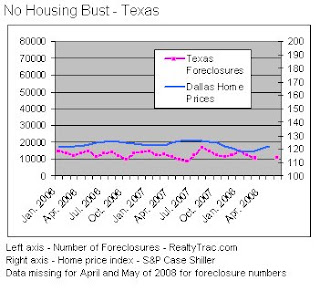
Tale of Two Housing Markets
A while back I mentioned this in an op-ed, but I thought that a graphic representation would be good to see. I updated the numbers to reflect the most recent available data from RealtyTrac.com and Case-Shiller. I think the graphs speak for themselves.



Sunday, August 10, 2008
You Assume Too Much
For many on the left, there is an easy equation to promote energy independence and protect the environment: Less driving, more density, and more rail transit. Even noted economists like Greg Mankiw have supported a Pigovian gas tax to encourage precisely these three behaviors. The question not asked is whether these idealistic behaviors can even be achieved.
Would higher gas prices push people to move to mass transit or into the city? Hardly at all. Recently, the American Dream Coalition released a fact sheet entitled “Rails Won’t Save America”. In it, they challenge many of the assumptions that so many take for granted. According to the Fact Sheet, while driving has dropped by 4% since last year, mass transit has increased by 3.4%. This seems to support mass transit until you realize that the 4% of driving represents 15.4 billion miles. Mass Transit has only increased a mere 455 million passenger miles. That is to say, only 3% of the reduction in driving miles has gone to mass transit. If gasoline at over $3 doesn’t increase mass transit on a broad scale, any incentive would have to be enormous to cause it.
The problems with using mass transit and forcing density as a solution to oil consumption are many. First, mass transit is inescapably inconvenient. I tried it, and for me it added an additional 50 minutes each way to my one way 40-minute commute. For a typical mid-level office worker making $30/hr and valuing his or her personal time at that rate equates to a loss of $10,000 a year. At $4/gallon, I would spend less than $2,000 in gas to commute in my Honda Accord. To understand why people are not moving to mass transit is easy. If I was going to spend an extra 100 minutes away from home it would be working on getting a promotion, not on mass transit.
Secondly, mass transit is becoming increasingly subsidized. Few have made note that while gas and diesel prices have surged, bus fairs have not. Electricity rates have surged along with natural gas and oil, yet electric powered rail prices have not. Cities are simply eating the costs. This is a dishonest as the U.S. Post Office’s recent television ads bragging that they do not charge fuel surcharges, and then also announcing a $1.1 Billion quarterly loss due to high fuel costs. The government folds to political pressure by the rent-seeking public, keeping prices lower than costs.
Mass transit is inherently inferior because a car can travel to and from a near infinite number of locations, while a rail system can only serve a couple dozen locations. This loss of convenience necessitates that it takes longer. Political pressures often dictate transit locations further slowing trips with unnecessary stops. Only draconian changes to development patterns could over come the inherent limits to mass transit.
It is also unlikely, without massive incentives, to get large numbers of people to move into the city center. Pleasant communities near the city center are often very expensive already. If the hundreds of thousands of new residents needed to support a large mass transit system were to move into these areas the prices would skyrocket into the stratosphere. While, at the same time, prices in the sprawling suburbs would plunge, maintaining overall affordability. It is likely that many employers would simply move out to the suburbs and not remain in the city because they could attract workers wanting the low cost of living. In the long run, Dr. Mankiw’s gas tax idea would simply limit the number of job opportunities for everyone by increasing the cost of traveling to jobs that are further away. Any real achievement towards the end he seeks would be small at best.
The simple equation of less driving, more density, and more mass transit, is more dream than reality. Unfortunately, Dr. Mankiw does not seem to think deeply about how people would behave under his policy suggestion or he would realize it won’t work. The Fact Sheet put out by the American Dream Coalition has a lot of great information debunking myths about mass transit helping the environment. At only six pages and lots of graphics, I suggest everyone give it a look see. The link again here.
Hat Tip to Tory on the Fact Sheet
Would higher gas prices push people to move to mass transit or into the city? Hardly at all. Recently, the American Dream Coalition released a fact sheet entitled “Rails Won’t Save America”. In it, they challenge many of the assumptions that so many take for granted. According to the Fact Sheet, while driving has dropped by 4% since last year, mass transit has increased by 3.4%. This seems to support mass transit until you realize that the 4% of driving represents 15.4 billion miles. Mass Transit has only increased a mere 455 million passenger miles. That is to say, only 3% of the reduction in driving miles has gone to mass transit. If gasoline at over $3 doesn’t increase mass transit on a broad scale, any incentive would have to be enormous to cause it.
The problems with using mass transit and forcing density as a solution to oil consumption are many. First, mass transit is inescapably inconvenient. I tried it, and for me it added an additional 50 minutes each way to my one way 40-minute commute. For a typical mid-level office worker making $30/hr and valuing his or her personal time at that rate equates to a loss of $10,000 a year. At $4/gallon, I would spend less than $2,000 in gas to commute in my Honda Accord. To understand why people are not moving to mass transit is easy. If I was going to spend an extra 100 minutes away from home it would be working on getting a promotion, not on mass transit.
Secondly, mass transit is becoming increasingly subsidized. Few have made note that while gas and diesel prices have surged, bus fairs have not. Electricity rates have surged along with natural gas and oil, yet electric powered rail prices have not. Cities are simply eating the costs. This is a dishonest as the U.S. Post Office’s recent television ads bragging that they do not charge fuel surcharges, and then also announcing a $1.1 Billion quarterly loss due to high fuel costs. The government folds to political pressure by the rent-seeking public, keeping prices lower than costs.
Mass transit is inherently inferior because a car can travel to and from a near infinite number of locations, while a rail system can only serve a couple dozen locations. This loss of convenience necessitates that it takes longer. Political pressures often dictate transit locations further slowing trips with unnecessary stops. Only draconian changes to development patterns could over come the inherent limits to mass transit.
It is also unlikely, without massive incentives, to get large numbers of people to move into the city center. Pleasant communities near the city center are often very expensive already. If the hundreds of thousands of new residents needed to support a large mass transit system were to move into these areas the prices would skyrocket into the stratosphere. While, at the same time, prices in the sprawling suburbs would plunge, maintaining overall affordability. It is likely that many employers would simply move out to the suburbs and not remain in the city because they could attract workers wanting the low cost of living. In the long run, Dr. Mankiw’s gas tax idea would simply limit the number of job opportunities for everyone by increasing the cost of traveling to jobs that are further away. Any real achievement towards the end he seeks would be small at best.
The simple equation of less driving, more density, and more mass transit, is more dream than reality. Unfortunately, Dr. Mankiw does not seem to think deeply about how people would behave under his policy suggestion or he would realize it won’t work. The Fact Sheet put out by the American Dream Coalition has a lot of great information debunking myths about mass transit helping the environment. At only six pages and lots of graphics, I suggest everyone give it a look see. The link again here.
Hat Tip to Tory on the Fact Sheet
Wednesday, August 6, 2008
Housing Bubble - LA vs. Phoenix
I recently read some criticisms about housing prices being caused by restricted supply. This person wanted to know why Phoenix had a housing boom without severe growth restrictions.
The boom in Phoenix was probably not caused by supply restrictions as much as the boom was in other cities. The primary causes of the boom in Phoenix were mass emigration from Southern California and massive capital flows from Southern California.
My graphs compare population growth rates to home prices, using census data and the Case-Shiller Index.

What you can see in the graph is the population growth in Phoenix is highly correlated to price increases. However, in Los Angeles, this is not so. There is a clear inverse relationship between population and home prices. Whereas the boom in Phoenix can be at least partially explained by increased demand, the same cannot be said for Los Angeles. In the year before prices hit their peak, the population in the Los Angeles metro was beginning to decline. What explains this paradox? A restriction on supply.
The boom in Phoenix was probably not caused by supply restrictions as much as the boom was in other cities. The primary causes of the boom in Phoenix were mass emigration from Southern California and massive capital flows from Southern California.
My graphs compare population growth rates to home prices, using census data and the Case-Shiller Index.

What you can see in the graph is the population growth in Phoenix is highly correlated to price increases. However, in Los Angeles, this is not so. There is a clear inverse relationship between population and home prices. Whereas the boom in Phoenix can be at least partially explained by increased demand, the same cannot be said for Los Angeles. In the year before prices hit their peak, the population in the Los Angeles metro was beginning to decline. What explains this paradox? A restriction on supply.
Actuaries on Social Security
My occupation is as an actuary. For those who aren't sure what that is, you can check here. In brief, actuaries are the people who run the numbers for insurance systems. Social Security is very similar to an insurance system and many actuaries are employed by the Social Security Administration.
On Monday, the American Academy of Actuaries, of which I am a member, released a report outlining their suggestions for fixing social security in the WSJ. In my experience actuaries tend not to be ardently in favor of free markets for reasons that I do not fully understand. Given that they still came out in favor of decreasing Social Security payments.
I agree with almost all of their reasoning, but I am still somewhat skeptical of moving up the retirement age as an equitable solution as I have said before here.
Some quotes that I thought were good:
"We think that if you dig in and make these changes now ... it gives people time to plan," said Tom Terry, the organization's vice president for pension issues. "It gives people time to anticipate that now I'm age 35, I'm looking at an age 68 or 69 retirement for Social Security, and that gives you a lot of years to plan for it."
"If we delay and wait, we're more likely as a nation to have to sort of jolt the system much more potently and hurt a lot more people unexpectedly,"
I would prefer a straight cut on everyone's benefits below a certain age, but making cuts of some kind, which raising the retirement age does, are necessary.
On Monday, the American Academy of Actuaries, of which I am a member, released a report outlining their suggestions for fixing social security in the WSJ. In my experience actuaries tend not to be ardently in favor of free markets for reasons that I do not fully understand. Given that they still came out in favor of decreasing Social Security payments.
I agree with almost all of their reasoning, but I am still somewhat skeptical of moving up the retirement age as an equitable solution as I have said before here.
Some quotes that I thought were good:
"We think that if you dig in and make these changes now ... it gives people time to plan," said Tom Terry, the organization's vice president for pension issues. "It gives people time to anticipate that now I'm age 35, I'm looking at an age 68 or 69 retirement for Social Security, and that gives you a lot of years to plan for it."
"If we delay and wait, we're more likely as a nation to have to sort of jolt the system much more potently and hurt a lot more people unexpectedly,"
I would prefer a straight cut on everyone's benefits below a certain age, but making cuts of some kind, which raising the retirement age does, are necessary.
Monday, August 4, 2008
McCain on School Choice
Sen. John McCain had an op-ed published today in the New York Daily News. Most of it was great, while other parts were mostly meaningless rhetoric. Here are some excerpts:
"Beyond that, the education debate divides quickly into two camps. Some say all that's needed is more taxpayer money, along with more prekindergarten and after-school programs. Others believe that the basic structure of the education system is flawed, and that fundamental reform is needed. You can put me squarely on the side of major reform."
Bravo.
"The chancellor [Joel Klein of NY City] speaks for many, and especially for parents who cannot afford a private school. Consider the example of the Opportunity Scholarship program in Washington, D.C., which serves more than 1,900 children from families with an average income of $23,000 a year. More than 7,000 more families have applied for that program. What they all share is the desire to get their kids into a better school.
Yet Democrats in Congress, including my opponent, Sen. Obama, oppose this program. Not long ago, addressing the American Federation of Teachers, he dismissed public support for private school vouchers for low-income Americans as "tired rhetoric about vouchers and school choice." That went over well with the teachers union, but where does it leave children who are stuck in failing schools?"
What? The candidate of "change" leading us boldly along the status quo? Surely not.
"if Sen. Obama continues to defer to the teachers unions, instead of committing to real reform, then he should start looking for new slogans. "
Maybe he does need new slogans -
Rasmussen Tracking Poll - McCain 47% - Obama 46%
"Beyond that, the education debate divides quickly into two camps. Some say all that's needed is more taxpayer money, along with more prekindergarten and after-school programs. Others believe that the basic structure of the education system is flawed, and that fundamental reform is needed. You can put me squarely on the side of major reform."
Bravo.
"The chancellor [Joel Klein of NY City] speaks for many, and especially for parents who cannot afford a private school. Consider the example of the Opportunity Scholarship program in Washington, D.C., which serves more than 1,900 children from families with an average income of $23,000 a year. More than 7,000 more families have applied for that program. What they all share is the desire to get their kids into a better school.
Yet Democrats in Congress, including my opponent, Sen. Obama, oppose this program. Not long ago, addressing the American Federation of Teachers, he dismissed public support for private school vouchers for low-income Americans as "tired rhetoric about vouchers and school choice." That went over well with the teachers union, but where does it leave children who are stuck in failing schools?"
What? The candidate of "change" leading us boldly along the status quo? Surely not.
"if Sen. Obama continues to defer to the teachers unions, instead of committing to real reform, then he should start looking for new slogans. "
Maybe he does need new slogans -
Rasmussen Tracking Poll - McCain 47% - Obama 46%
Friday, August 1, 2008
Exxon and Corporate Taxes
Yesterday the media ran with the news that Exxon had set yet another record quarterly profit number. $11.6 Billion. What should really make your jaw drop is what Dr. Mark Perry at his blog Carpe Diem reports. First this post.
Exxon has already paid $19.828 billion in income taxes for 2008 (data here), and will probably pay almost $40 billion in income taxes this year (see graph above, income tax data for 1999-2007 taken from Exxon's annual reports).
To put $40 billion of income taxes in perspective, it can be reasonably estimated that Exxon will pay more in income taxes this year than the entire bottom 50% of American individual taxpayers (about 67 million) will pay in taxes this year.
It gets even better here.
When you count all taxes, not just corporate taxes, for just the 2nd quarter of 2008:
(From CNN) Buried in the story we also find that "In addition to making hefty profits, Exxon also had a hefty tax bill. Worldwide, the company paid $10.5 billion in income taxes in the second quarter, $9.5 billion in sales taxes, and over $12 billion in what it called 'other taxes.'"
MP: In other words, Exxon Mobil paid (or at least collected) $32.361 billion in taxes in the second quarter, which works out to $4,114 in taxes per second. Another way to look at it - Exxon paid (or collected) almost $3 in taxes ($32.361 billion) for every $1 in profits ($11.68 billion)
He has a couple smart graphs in the first post.
Exxon has already paid $19.828 billion in income taxes for 2008 (data here), and will probably pay almost $40 billion in income taxes this year (see graph above, income tax data for 1999-2007 taken from Exxon's annual reports).
To put $40 billion of income taxes in perspective, it can be reasonably estimated that Exxon will pay more in income taxes this year than the entire bottom 50% of American individual taxpayers (about 67 million) will pay in taxes this year.
It gets even better here.
When you count all taxes, not just corporate taxes, for just the 2nd quarter of 2008:
(From CNN) Buried in the story we also find that "In addition to making hefty profits, Exxon also had a hefty tax bill. Worldwide, the company paid $10.5 billion in income taxes in the second quarter, $9.5 billion in sales taxes, and over $12 billion in what it called 'other taxes.'"
MP: In other words, Exxon Mobil paid (or at least collected) $32.361 billion in taxes in the second quarter, which works out to $4,114 in taxes per second. Another way to look at it - Exxon paid (or collected) almost $3 in taxes ($32.361 billion) for every $1 in profits ($11.68 billion)
He has a couple smart graphs in the first post.
Subscribe to:
Posts (Atom)